This is a carousel of product images. Use the thumbnails or swipe to change the displayed image, and activate an image to open it full screen.


CH07 Shell lounge chair, oiled oak - cognac leather Sif 95
Description
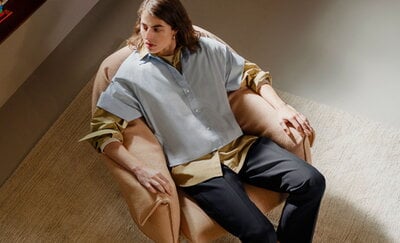
The story of the CH07 Shell lounge chair by Carl Hansen & Søn isn’t quite traditional: Hans J. Wegner created the Shell Chair already in 1963, but the design was ahead of its time and did not reach the general public’s acceptance. Carl Hansen & Søn introduced the Shell chair again in 1998, resulting in immediate success. Since then, the chair has redeemed its position as a modern classic of Danish design.
The sophisticated and airy silhouette of the CH07 Shell chair consists of a sleek solid wood frame and a curved, wing-like seat and backrest upholstered in leather. Wegner believed that a chair should always be comfortable to sit on and beautiful to look at from all sides and angles. Crafted by hand in Denmark, the Shell lounge chair is a perfect example of this.
- Width: 36.22 in (92 cm)
- Depth: 32.68 in (83 cm)
- Height: 29.13 in (74 cm)
- Seat height: 13.78 in (35 cm)
- Colour Oiled oak, cognac
- Frame material Oiled oak
- Upholstery fabric Sif 95 leather
- Product ID: CHS-CH07-020-102-HR-FSC-70-SIF95

Hans J. Wegner (1914–2007) was a world-renowned Danish designer, celebrated above all for his exceptional chairs. Perhaps the most iconic of them is the Wishbone Chair, produced by Carl Hansen & Søn, which has remained in continuous production since 1950.
Wegner is also remembered as a pioneer of Danish modernism and as one of the leading figures of the golden age of Nordic design.
Hans J. Wegner – designer of 500 chairs
Hans Jørgensen Wegner was a Danish furniture designer whose organic and elegant lines played a pivotal role in bringing Danish wooden furniture to global prominence in the 1950s.
Wegner had a remarkable ability to unite functionality and aesthetics – many of his designs carry a sense of playfulness, while others are almost poetically beautiful. Meticulously crafted joinery, organic forms and the thoughtful combination of materials such as solid wood, veneer and paper cord give his work a timeless appeal that still feels relevant today.
A lifelong love of wood
Born in Tønder in southern Denmark, Wegner developed an early fascination with woodcarving and often visited museums in search of inspiration for his creations. This passion led him to train as a cabinetmaker in the 1930s under master craftsman H. F. Stahlberg. In 1936, he chose to further his studies in design – and the rest is history.
Wood remained Wegner’s material of choice throughout his career, often taking centre stage in his chair designs.
Ergonomics first
For Wegner, ergonomics was one of the most essential aspects of chair design – after all, a chair is something the human body interacts with for extended periods. Over the course of his long career, he designed around 500 different chairs, each combining beauty and function in its own distinctive way. Many of them are now highly sought-after design classics.
Among them is the CH24 Wishbone Chair from 1949, whose Y-shaped backrest and paper cord seat have made it one of the most recognisable chairs of the 20th century.
International awards and recognition
Throughout his career, Wegner received numerous prestigious awards, including the Lunning Prize and the Grand Prix at the Milan Triennale in 1951, the Prince Eugen Medal in 1961 and the C.F. Hansen Medal in 1980.
His furniture is also part of the collections of major museums, including the Museum of Modern Art in New York.
Who: Hans J. Wegner
- Danish furniture designer (1914–2007).
- Designed around 500 chairs during his career.
- A key figure in the international breakthrough of Danish modernism in the 1950s.
- Wood was his most important and beloved material.
- Notable works: Wishbone Chair, Shell Chair, Nesting Tables, Opala lamps (Carl Hansen & Søn), Wegner lounge chairs (Fredericia).
Read more in Design Stories
View all products
Ideas and inspiration
This is a carousel. Use Next and Previous buttons to navigate.