Tynell in Helsinki: Exploring Paavo Tynell’s lighting in the city’s landmarks
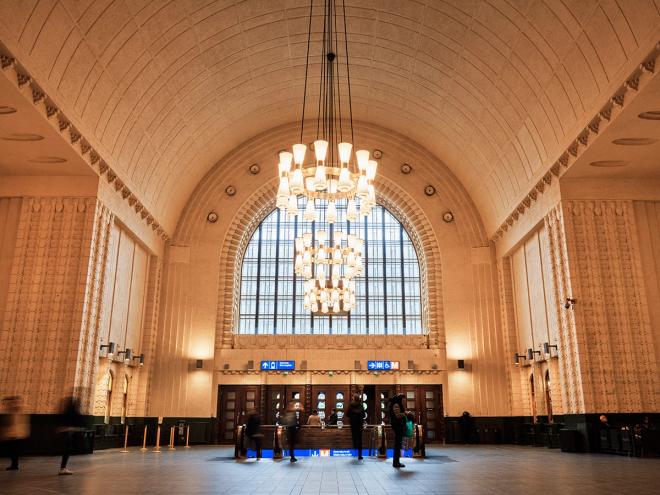
Since its inauguration in 1919, Helsinki Central Station has at times been hailed as one of the world’s most beautiful.
Helsinki Central Station
Arriving in Helsinki, or departing from it, travelers are met by design masterworks from some of the greatest figures in 20th-century Finnish design. Completed in 1919, Helsinki Central Station features art nouveau architecture by Eliel Saarinen, sculpture by Emil Wikström, and lighting by Paavo Tynell.
Frequently cited as one of the world’s most beautiful railway terminals, Helsinki Central Station is distinguished externally by Wikström’s four towering statues, the Lyhdynkantajat (‘lantern bearers’), and internally by Tynell’s grand chandeliers that hang in the main hall. This was not the only project that brought Tynell and Wikström together – both were co-founders of Taito Oy, the company which manufactured the lights.
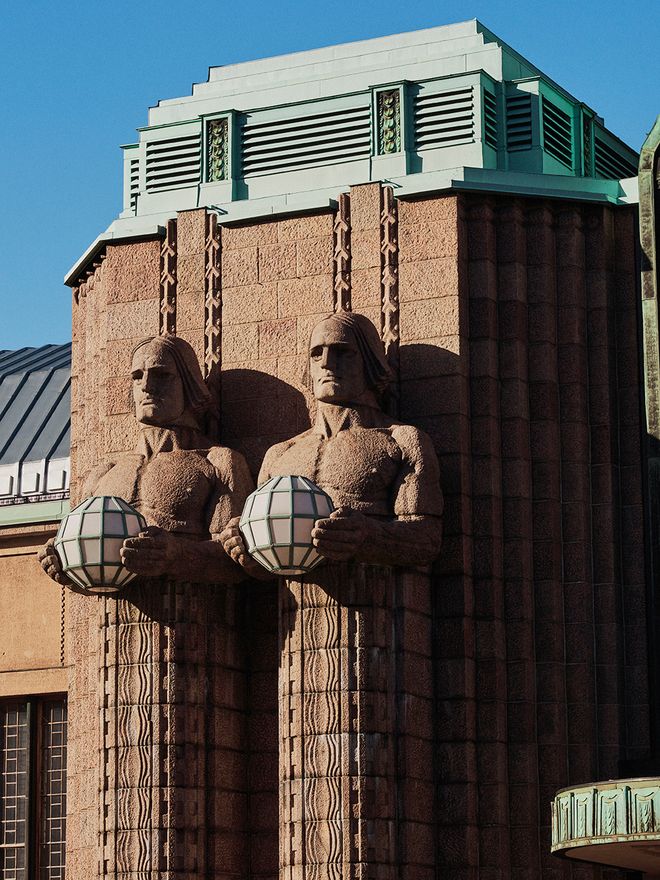
Emil Wikström’s statues serve as mascots for the railway station designed by architect Eliel Saarinen.
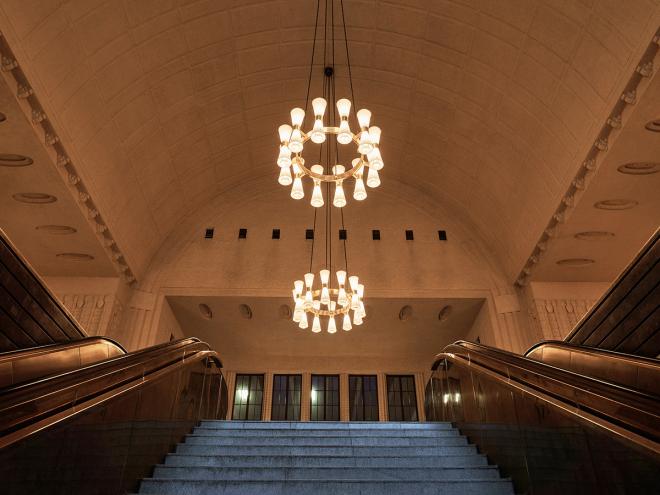
Paavo Tynell’s neoclassical chandeliers have graced Helsinki Central Station since the 1950s.
Tynell’s neoclassical chandeliers are instantly recognizable to those familiar with the station, representing homecoming to many Finns. They have hung in the main hall since the 1950s, when they were installed to replace earlier, more ornate designs that were destroyed in a fire that broke out in one of the restaurants on June 14, 1950.
Tynell’s neoclassical chandeliers are instantly recognizable to those familiar with the station, representing homecoming to many Finns.
Although the station has gone through many changes over the years, Eliel Saarinen’s landmark architecture has been meticulously preserved.
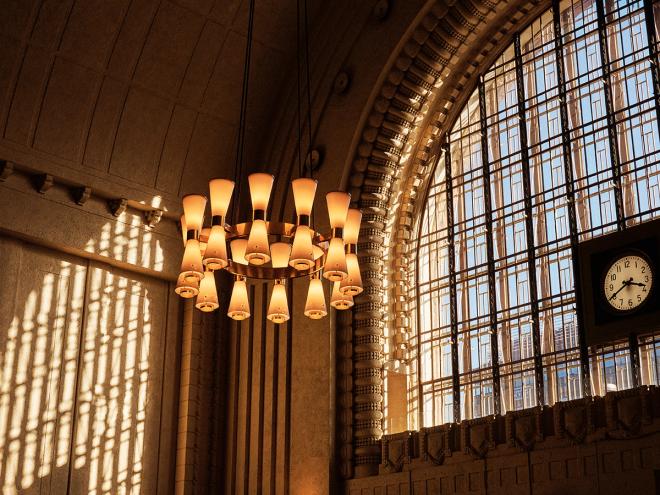
Comprising rings of frosted glass shades clutched like paper scrolls in a polished brass frame, the magnificent chandeliers have cast their warm, welcoming glow over the comings and goings of Helsinki for over 70 years.
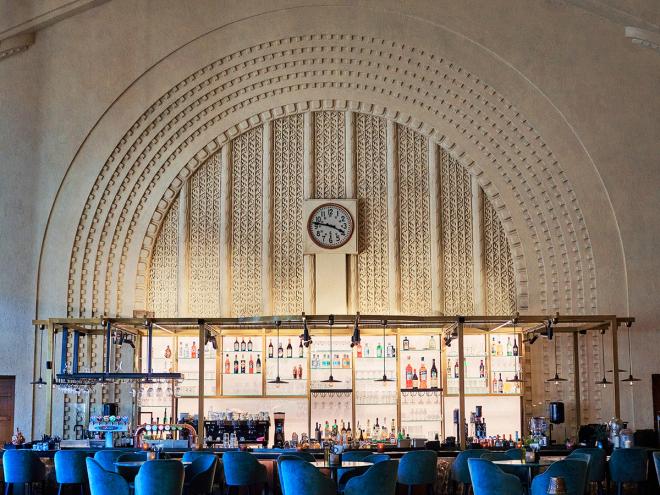
What was once the ticket hall is today a thriving restaurant, with the old ticket office’s clock now keeping time at the bar.
Helsinki School of Economics
Built as the Helsinki School of Economics in 1950, and reborn as the home of Aalto University Executive Education in 2020, this striking building in central Helsinki has educated Finland’s economic elite for over 70 years.
A landmark example of 1950s modernist architecture, it was designed by architects Hugo Harmia and Woldemar Baeckman, with Paavo Tynell commissioned to design lighting for the interiors.
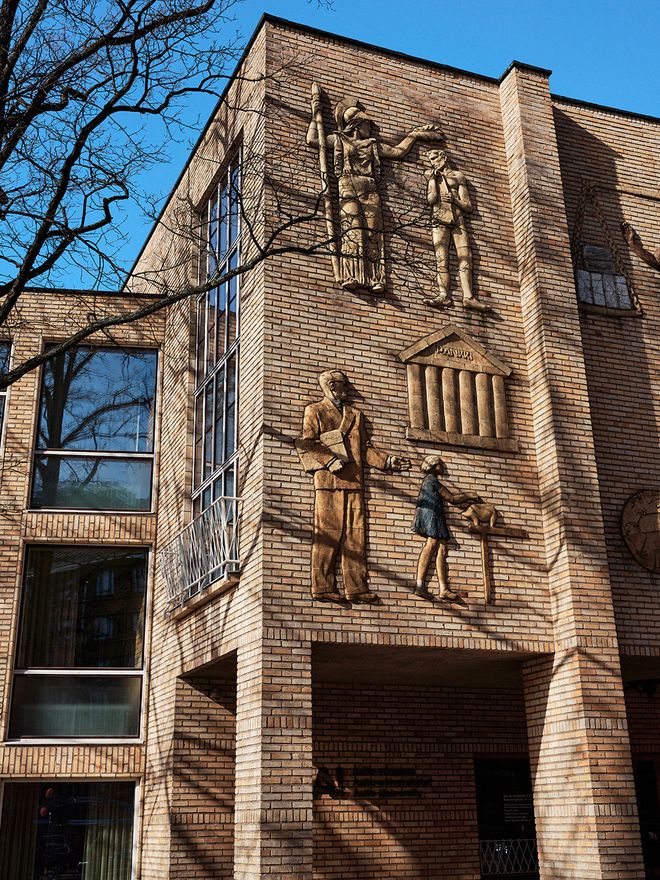
Helsinki School of Economics’ brick walls are adorned with sculptor Michael Schilkin’s relief.
Whereas the brick-built façade is striking for its impressive relief by sculptor Michael Schilkin, the school’s interiors are notable for their extraordinary materiality. Pine-paneled walls have patinated beautifully over time, creating the perfect backdrop to Tynell’s wall lamps, pendants, and recessed ceiling lamps in warm-toned brass.
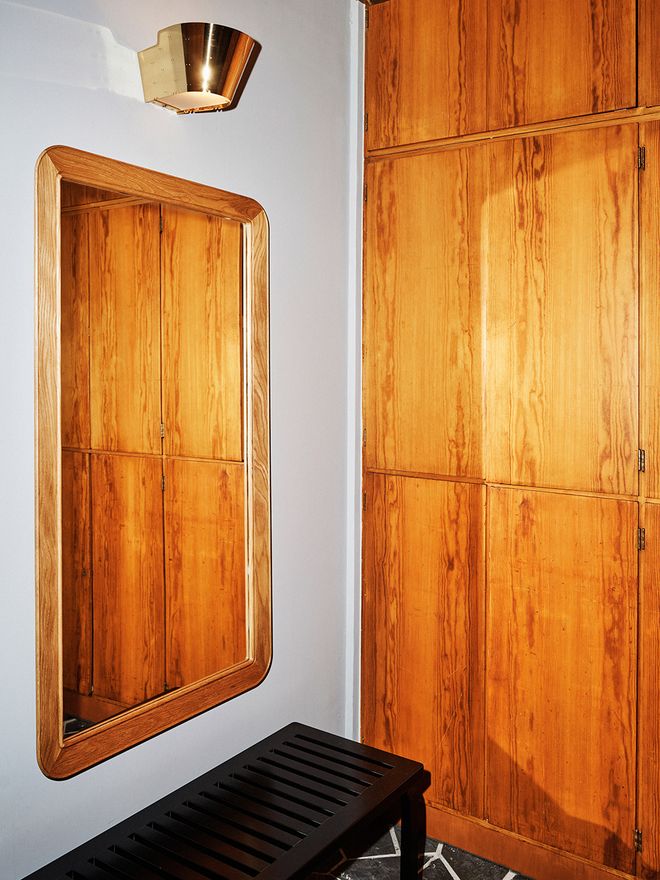
The school’s interiors feature ample pine paneling, and it’s easy to spot Tynell’s work in the perforated wall lamps.
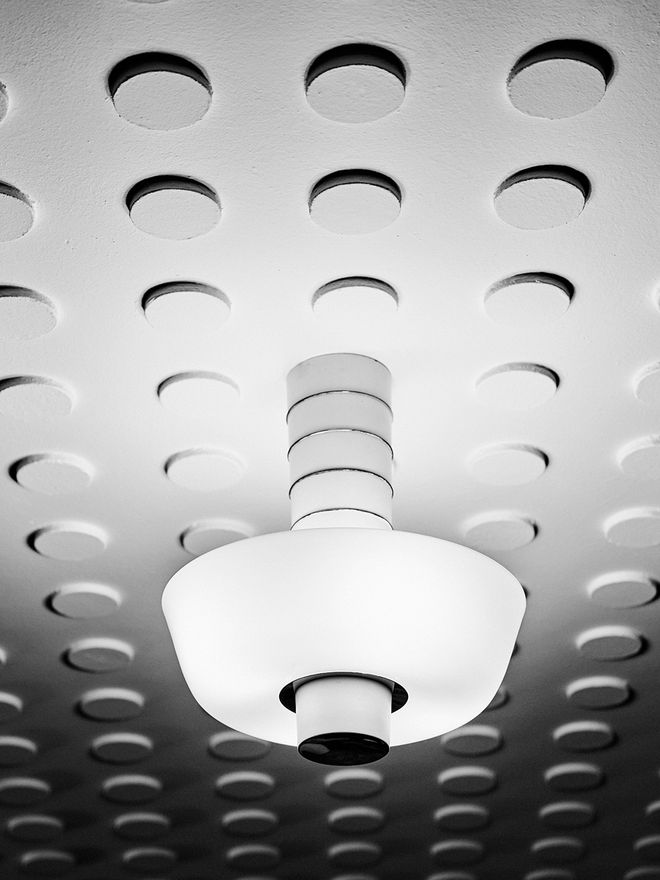
Tynell designed lighting for numerous spaces throughout the building. In addition to brass fixtures, he also designed glass and copper lights.
For the grand arched ballroom – arguably the space in which it is most important to get the atmosphere right – he devised wall lamps that delicately filtered the light through their perforated brass base, enriched with elaborate decorative features crafted from brass wire.
The restoration of the building in 2020 saw its most important public spaces returned to their former glory, while other areas were adapted to meet the needs of the new business school. More than 500 Tynell lamps were preserved in place, meticulously cleaned and polished to look as resplendent as the day they were first installed.
• Read also: Do you know this sophisticated gem of 1950s architecture? >
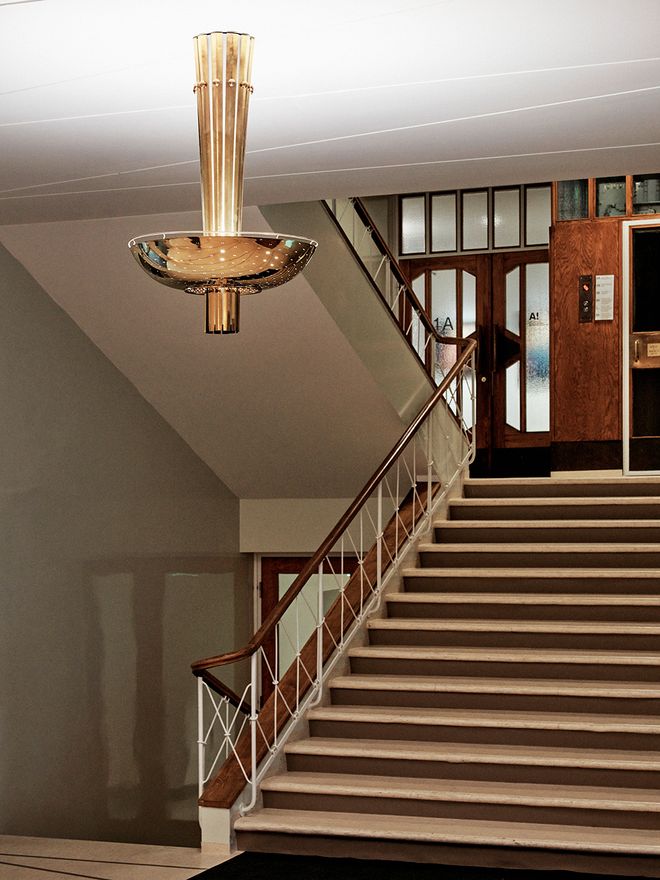
During the building’s restoration, Tynell’s lights were polished to their original splendor.
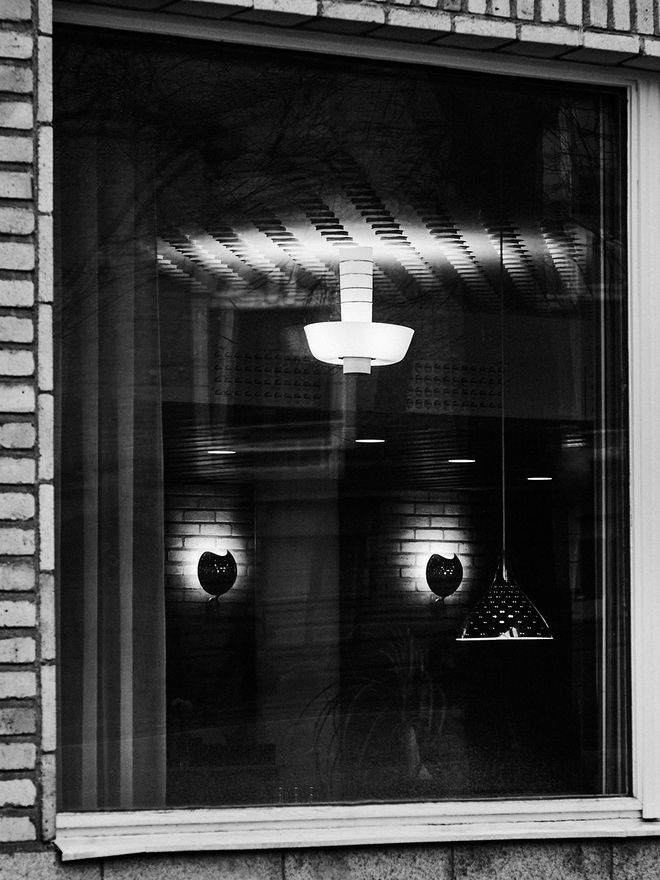
All in all, over 500 Tynell light fixtures can be found at the Helsinki School of Economics.
Original Sokos Hotel Vaakuna
The largest hotel in the Nordics when it opened in 1952, Hotel Vaakuna and its famous restaurant occupy the top five floors of the Sokos department store building in central Helsinki.
The work of architect Erkki Huttunen, the building’s functionalist façade is tempered on the inside with ornamental touches of the romantic. This, in part, is thanks to Paavo Tynell, who custom-designed numerous light fixtures for the property, including the rooms, lobby, and restaurant.
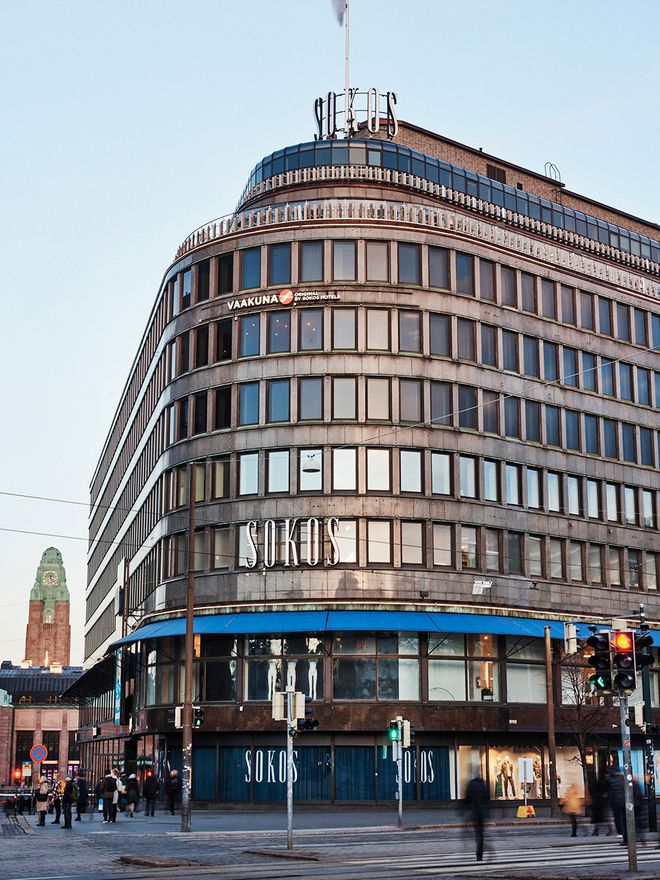
Original Sokos Hotel Vaakuna is located right next to Helsinki Central Station, in the upper floors of the Sokos department store building.
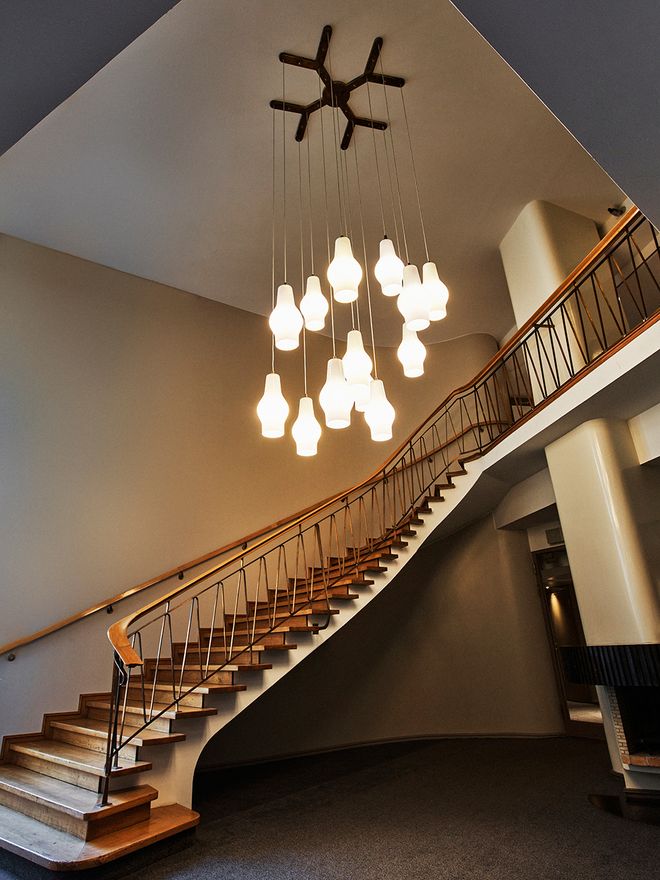
In the upper-floor lobby, you’ll find Tynell’s glass-domed chandelier with a snowflake-shaped base.
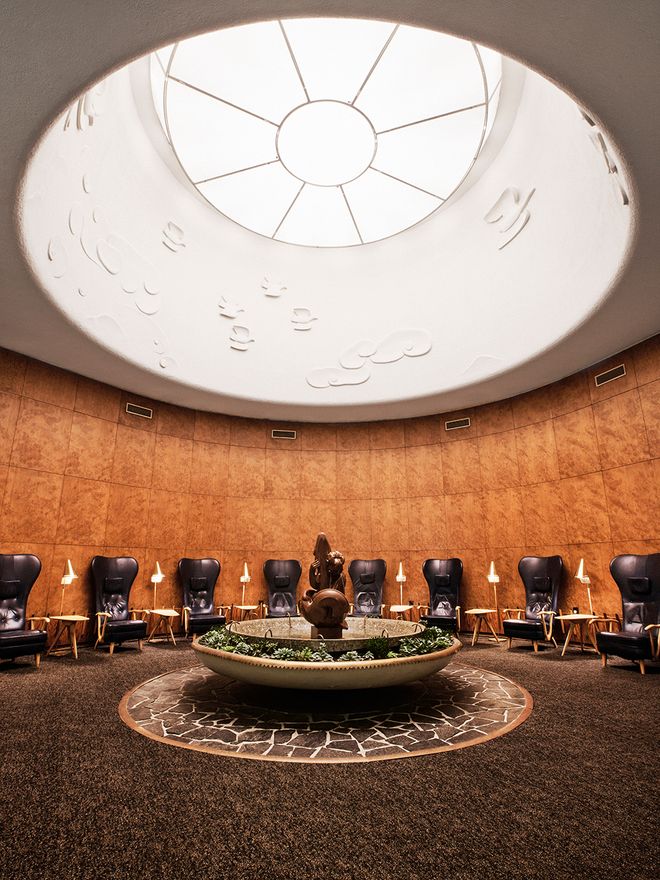
The grand armchairs in the wood-paneled lobby were designed by interior architect Runar Engblom.
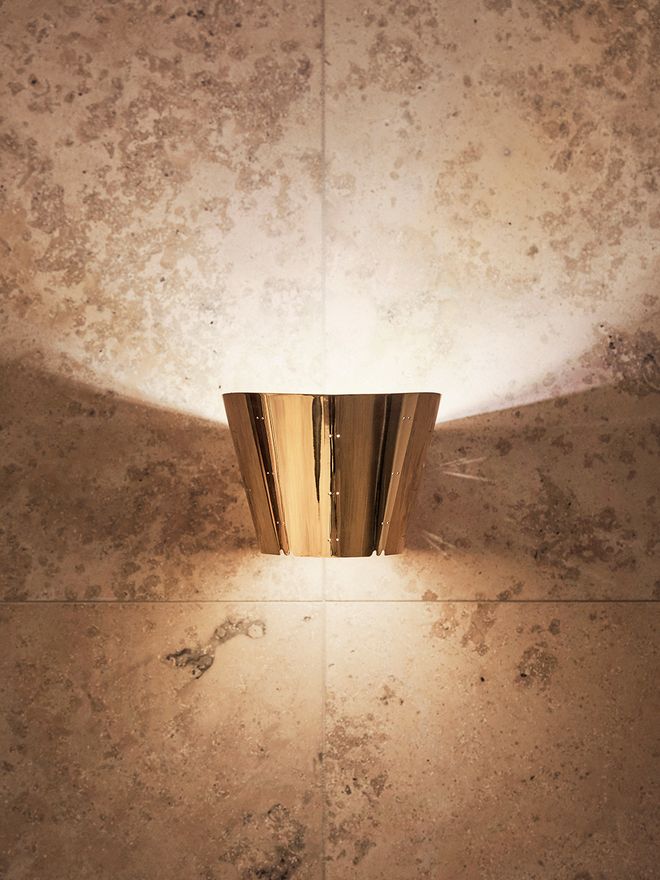
Golden sconces made from curved sheets of brass, hand-perforated to create a beautiful play of light, are fixed on the walls.
Housing one of the most extensive collections of Tynell designs that survives today, Hotel Vaakuna showcases the breadth of his distinctive style.
More than 20 conical brass reading lamps line the wood-paneled circular lobby, alongside high-backed armchairs by Runar Engblom – the former teacher of Helena Tynell, and the man who encouraged her to join Taito as an apprentice, thereby bringing husband and wife together.
Several styles of chandelier adorn the space, from delicate glass-lantern cascades to clusters of golden brass bells. Natural motifs abound, including snowflake-shaped canopies and exquisite flower details crafted from brass wire.
• Read also: Functionalist Hotel Vaakuna from the 1950s is filled with original lamps by Paavo Tynell >
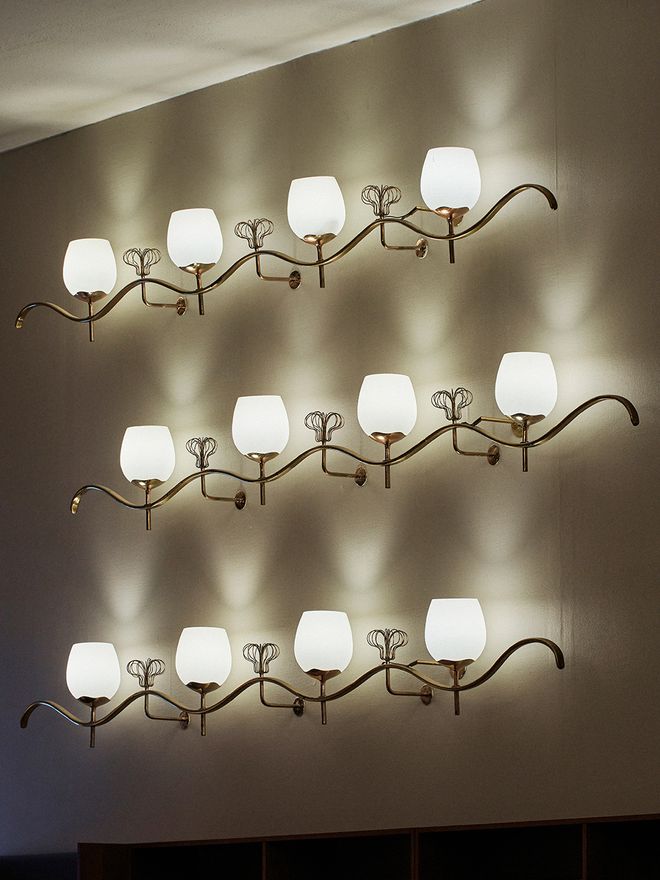
The delicate floral ornaments on the wall sconces are crafted from brass wire.
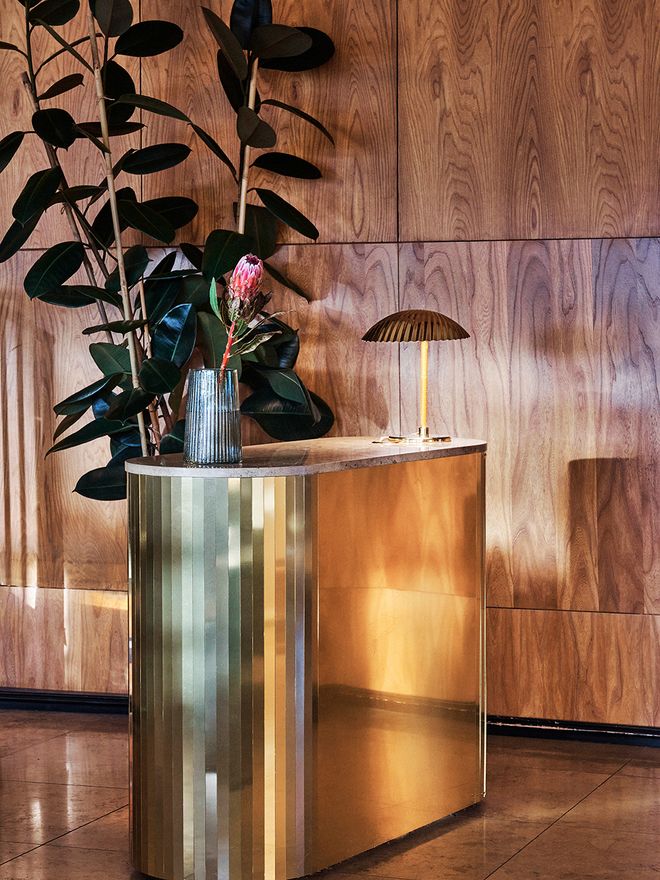
Tynell’s shell-like 5321 table lamp greets guests entering the 10th-floor restaurant hall.
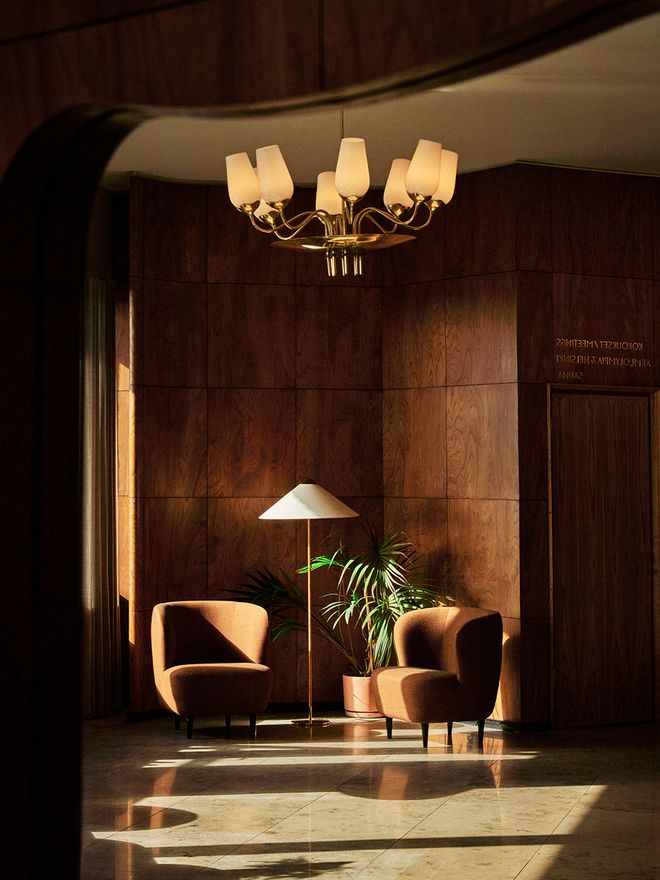
Another Tynell icon, the 9602 floor lamp, is on display at the hall.
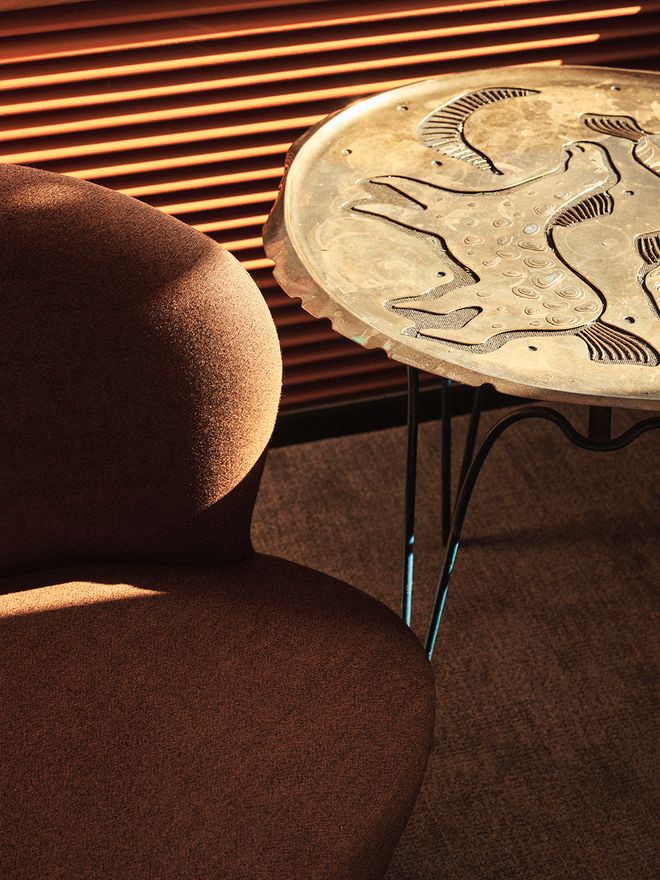
Tynell isn’t the only master craftsperson whose work appears in Hotel Vaakuna. Small tables engraved with animal designs are the work of his wife, Helena Tynell.
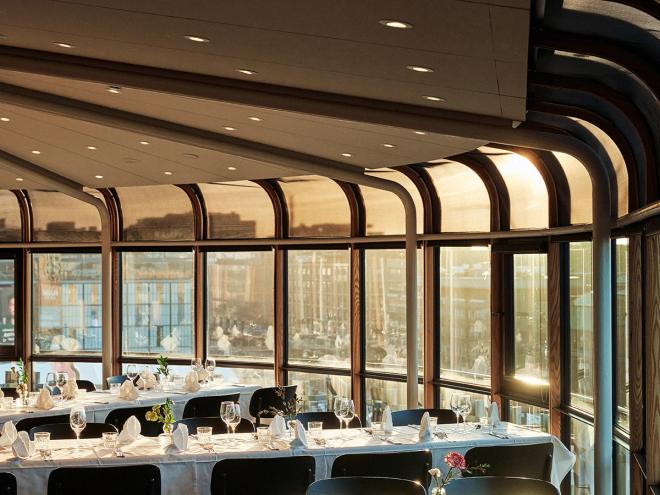
From the restaurant on the top floor, visitors can enjoy sweeping views of downtown Helsinki.
Meilahti Church
Designed by architect Markus Tavio and completed in 1954, the brick-built Meilahti Church is one of the most remarkable mid-century churches in Helsinki.
In front, hanging above the pews, the six chandeliers rank among the most extraordinary works of Paavo Tynell’s career. Consciously designed to evoke the crown of thorns worn by Christ on the cross, the asymmetric brass chandeliers are beautiful, but also rich with meaning.
Unlike the lights in most churches, they are dimmable, which allows the Meilahti clergy to adjust light level over the course of the day and season, and to create specific atmospheres for services, concerts, and celebrations.
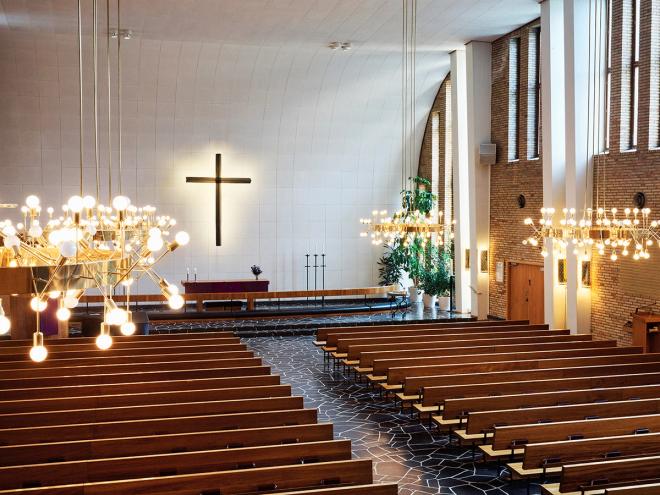
The lighting fixtures in Meilahti Church not only showcase Tynell’s technical prowess but also his profound understanding of the spiritual significance of light.
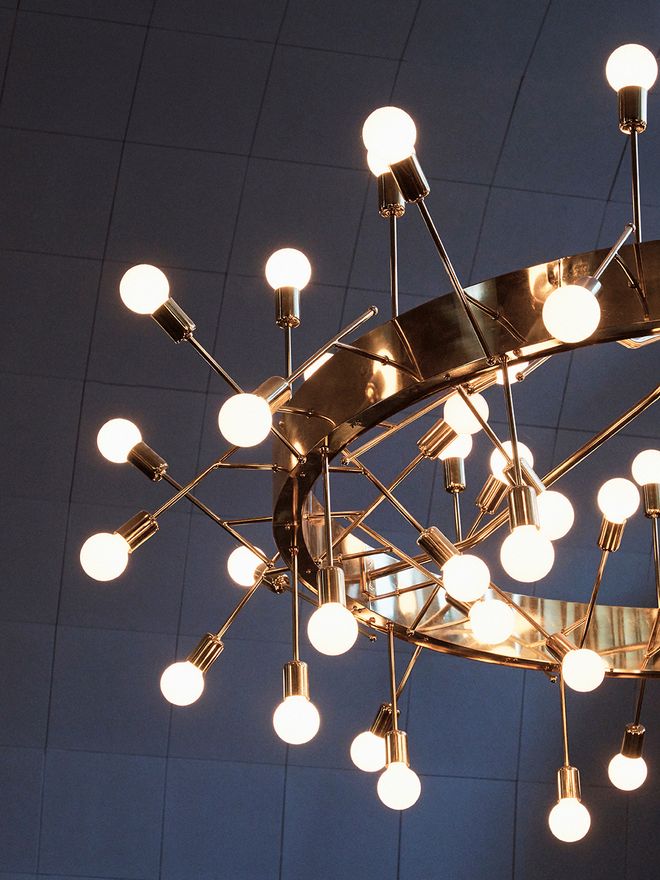
The chandelier’s unique shape is Tynell’s interpretation of a crown of thorns.
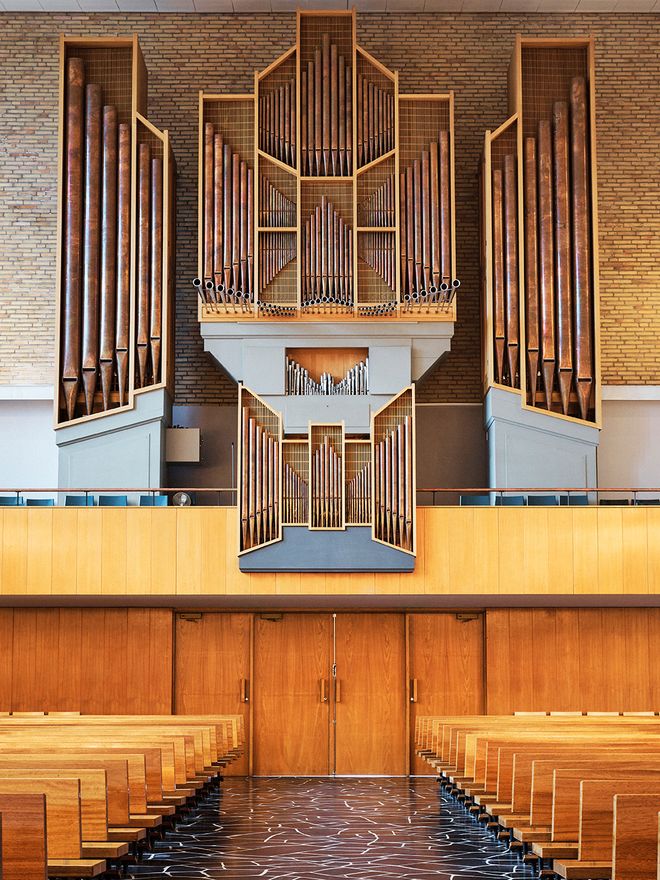
The church is home to a spectacular organ, crafted to resemble an abstract vision of an angel, by the Danish firm Marcussen & Søn.
In the context of a church, light acquires a special symbolic resonance that is absent from other settings. For Christians, light is inextricably interlinked with holiness. When designing for Meilahti Church, Tynell brought not only an aesthetic and functional knowledge of light, but also a spiritual understanding of its importance.
In the context of a church, light acquires a special symbolic resonance that is absent from other settings.
As well as the main light fixtures, Tynell also designed a number of wall lamps and chandeliers for Meilahti Church, as well as the font and the candelabra beside the altar.
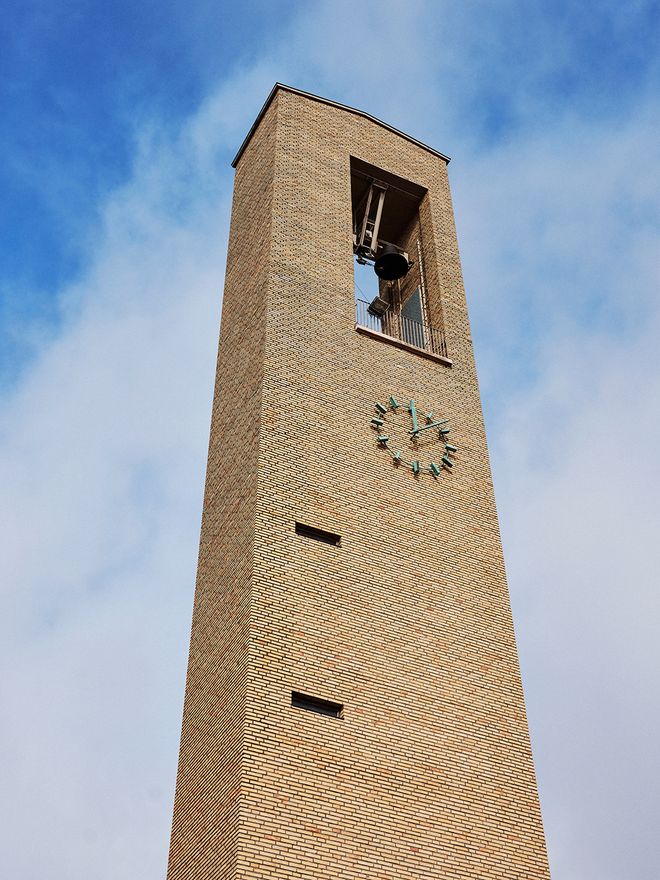
Designed by Markus Tavio, Meilahti Church was completed in 1954.
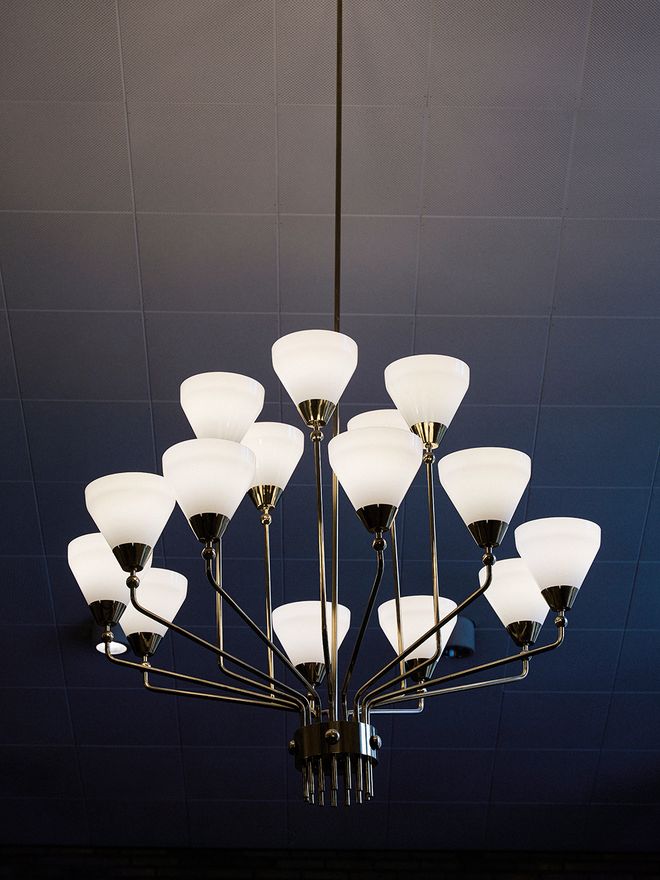
In addition to the thorn-inspired lights, Tynell also designed more classical chandeliers for the church.
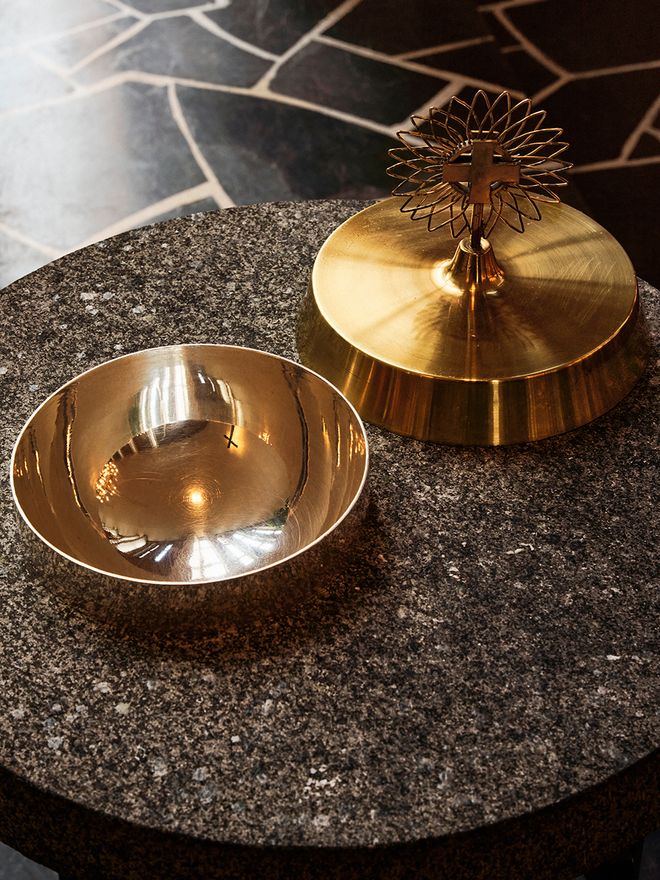
The ornate brass font is also a creation by Tynell.
See also:
• Lamps by Paavo Tynell >
• Read the story: Paavo Tynell’s lamps can be found in surprising places >
Text and images: GUBI Edit: Nora Uotila
The original story was published in GUBI’s Raisonné publication, issue 03. Republished exclusively in Design Stories.
Published on 25 Oct, 2023