This is a carousel of product images. Use the thumbnails or swipe to change the displayed image, and activate an image to open it full screen.
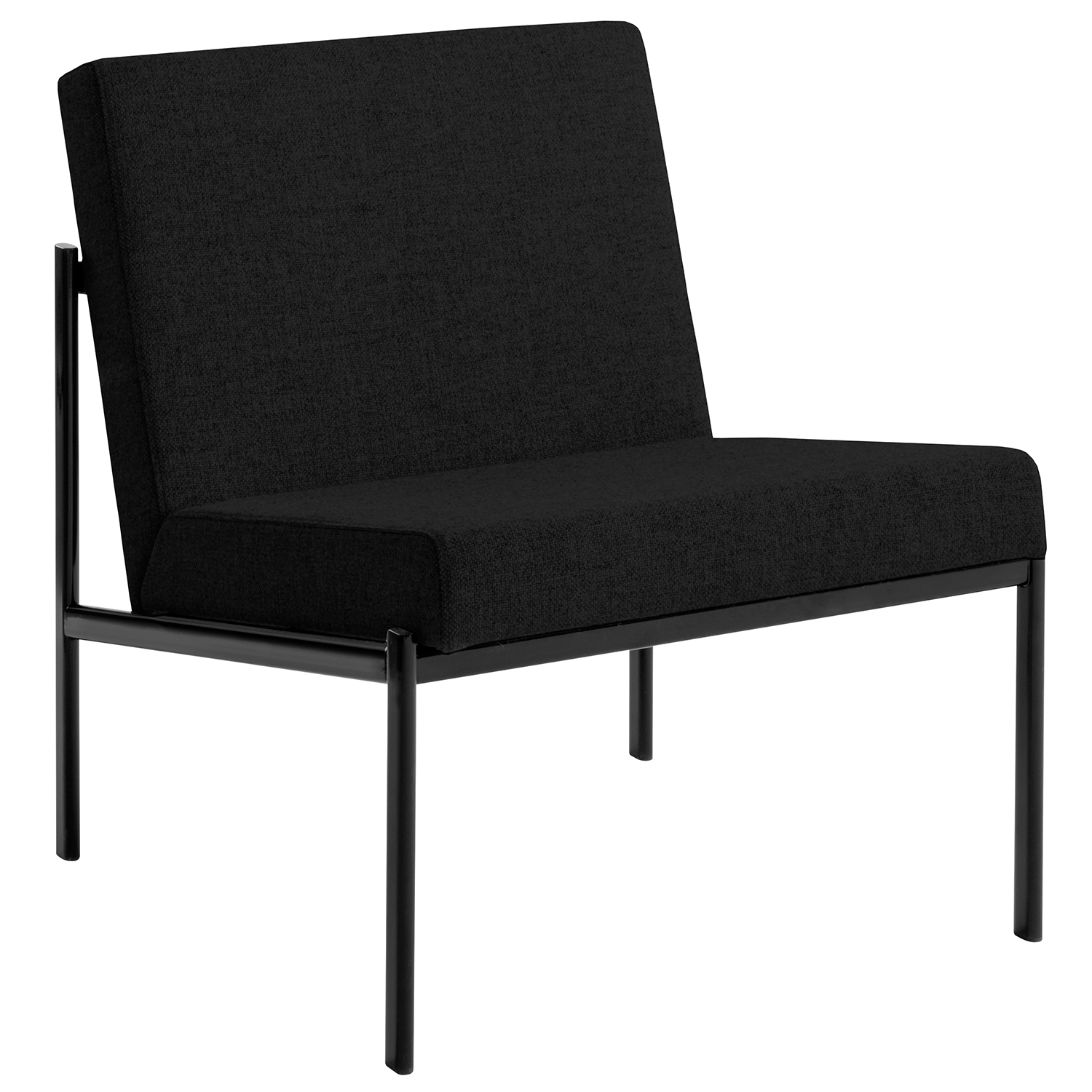

Kiki lounge chair, black
Description
Artek's Kiki lounge chair was designed by Ilmari Tapiovaara in 1960. The frame of the armchair is made of lacquered steel and the seat is upholstered with wool fabric by Kvadrat. Instead of wood, Tapiovaara decided to use oval steel tubing as the structural element in the Kiki series, giving its silhouettes an elegant and timeless spirit. Suitable for various kinds of use, Kiki has become one of the most popular pieces of public furniture in Finland, and it will easily find its place in modern homes, too.
- Width: 60 cm
- Depth: 75 cm
- Height: 68 cm
- Seat height: 39 cm
- Colour Black
- Frame material Lacquered steel
- Seat cushion Polyurethane foam, Dacron wadding
- Backrest cushion Polyurethane foam, Dacron wadding
- Upholstery fabric Kvadrat Hallingdal 65/190: 70% new wool, 30% viscose
- Abrasion resistance 100,000 Martindale
- Pilling 3
- Lightfastness 7
- Product ID: AK201371-HGD-190

Ilmari Tapiovaara (1914–1999) was a renowned Finnish interior architect and designer. He aimed to create humane, well-lit and welcoming environments, along with furniture that complemented them – for Tapiovaara, furniture was always part of a cohesive whole, with architecture serving as the foundation for his furniture design.
Tapiovaara also worked as a lecturer in interior design at the Helsinki University of Technology, where he sought to modernise the curriculum by steering it towards industrial product design, drawing inspiration from international examples.
Ilmari Tapiovaara – a pioneer of Finnish functionalism
Ilmari Tapiovaara was one of the most influential Finnish interior architects and designers of the 20th century. Often described as a designer who captured the essence of Finnish identity, his work distilled clarity, practicality and a close connection to nature into timeless forms.
Tapiovaara graduated from the furniture design programme at the Central School of Applied Arts in 1937. After graduating, he visited the Paris World Expo and, while staying in Paris, spent six months working in the studio of legendary architect Le Corbusier. Upon returning to Finland, Tapiovaara joined furniture manufacturer Asko, where he worked as both designer and artistic director for several years. Over the course of his career, he created dozens of iconic furniture pieces that have remained beloved classics from one generation to the next.
Wood, functionalism and equality
Wood was the defining element of Tapiovaara’s design language. He greatly admired Alvar Aalto and sought to carry Aalto’s ideals and philosophy into his own work. This can be seen in the strong functionalist spirit of his furniture: Tapiovaara paid close attention to manufacturability and believed deeply in democratic design. For him, functionalism and equality went hand in hand, and all design ultimately began with architecture.
With the curiosity of a researcher and the soul of a craftsman, Tapiovaara constantly searched for new ways to improve everyday objects. In addition to designing dozens of chair models and other furniture pieces – primarily for public spaces – he also created interiors for banks, offices, hotels and shops.
An internationally celebrated master of chairs
Throughout his long career, Tapiovaara frequently crossed the boundaries of traditional furniture design. His diverse body of work included wooden sculptures, film posters, sauna stoves, cutlery and even a portable grill. Still, he is best known for his iconic chair designs, including the Domus, Mademoiselle, Lukki and Aslak chairs, all produced by Artek.
Tapiovaara received a total of six gold medals at the Milan Triennales during the 1950s and 1960s. His many accolades also include the Good Design Award in Chicago in 1951, the Pro Finlandia Medal in 1959, the Finnish State Design Award in 1971 and the Furniture Prize of the Finnish Association of Interior Architects in 1990. These international honours cemented his place as one of the key figures in Finnish design history.
Who: Ilmari Tapiovaara
- Finnish interior architect and designer (1914–1999).
- Graduated from the Central School of Applied Arts in 1937.
- A passionate advocate of functionalism and democratic design.
- Awarded six gold medals at the Milan Triennale.
- Well-known products: Domus, Mademoiselle, Lukki and Aslak chairs by Artek.
Read more in Design Stories
View all products
Ideas and inspiration
This is a carousel. Use Next and Previous buttons to navigate.