This is a carousel of product images. Use the thumbnails or swipe to change the displayed image, and activate an image to open it full screen.
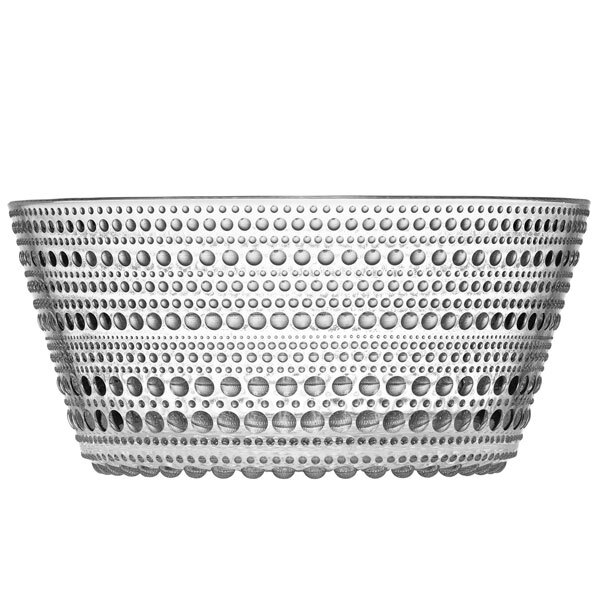
Kastehelmi bowl 1,4 L, clear
Description
In 1964 Oiva Toikka’s aim was to design a pattern that would conceal the joint marks in pressed glass. The result was Kastehelmi, Finnish for dewdrop, that features delicate glass droplets arranged in a series of rings. Kastehelmi became one of Toikka’s most beloved series of glassware and it was manufactured until 1988. The most popular items were brought back into Iittala’s production in 2010. Kastehelmi plays with light in the most beautiful way and suits any table setting.
- Capacity: 1.48 qt (1.4 l)
- Material Glass
- Colour Clear
- Product ID: II1015297

Oiva Toikka (1931–2019) was a Finnish designer and glass artist whose imaginative style brought boldness, abundance and playfulness to Nordic design. He is best known for the Birds by Toikka series and the Kastehelmi glassware he designed for Iittala.
Over the course of his career, Toikka also worked with stage art as well as ceramics and other materials, and his work has earned wide international acclaim.
Oiva Toikka brought colorful joy to Finnish glass design
Oiva Toikka is one of the great names of Finnish design. Having studied ceramics, Toikka began his career in the art department of Arabia, but it was above all as a glass artist that he rose to international fame. His expression was distinctive: where Scandinavian design is often known for a pared-back approach, Toikka’s work radiates abundance, humor and surprise.
Toikka’s beloved glass birds
Among Oiva Toikka’s best-known collections is the Birds by Toikka series made by Iittala, whose first bird, Flycatcher, was born in 1972 at the Nuutajärvi glassworks. Over the decades, the series grew into a vast family of birds, each mouth-blown piece an individual of its own.
Oiva Toikka’s glass birds are sought-after collector’s items around the world, and they have made Toikka’s name familiar to international audiences as well.
Kastehelmi and other favorites
Alongside the birds, among Toikka’s most famous works is the Kastehelmi series, inspired by dewdrops, which appeared in 1964 and later returned to production. The 1970 Tundra collection and the 1989 Fruits and Vegetables art glass series are also still in Iittala’s production.
Although glass was an especially important material for Toikka, his career also extended to ceramics, textiles, stage costumes and furniture design. His fearlessness and versatility made him an exceptionally wide-ranging designer.
Who: Oiva Toikka
- Finnish designer and glass artist (1931–2019).
- Began his career working with ceramics in the art department of Arabia.
- Best known for the Birds by Toikka glass birds and the Kastehelmi series he designed for Iittala.
- Also designed homeware and furniture, among other things, during his career.
- Awards: the Lunning Prize (1970), the Pro Finlandia Medal (1980), the Kaj Franck Design Prize (1992) and the Prince Eugen Medal (2001).
Read more in Design Stories
View all products5

Based on 2 reviews
-
C
Constance S | Verified Customer
Chicago, United States

I would suggest making the tumblers in larger sizes.
1 year ago
-
A
Anonyymi | Verified Customer
Tampere, Finland
Oikein kaunis ja sopivan kokoinen. Juuri sitä, mitä tilasin.
3 years ago
Ideas and inspiration
This is a carousel. Use Next and Previous buttons to navigate.