In the studio with designer Maria Bruun
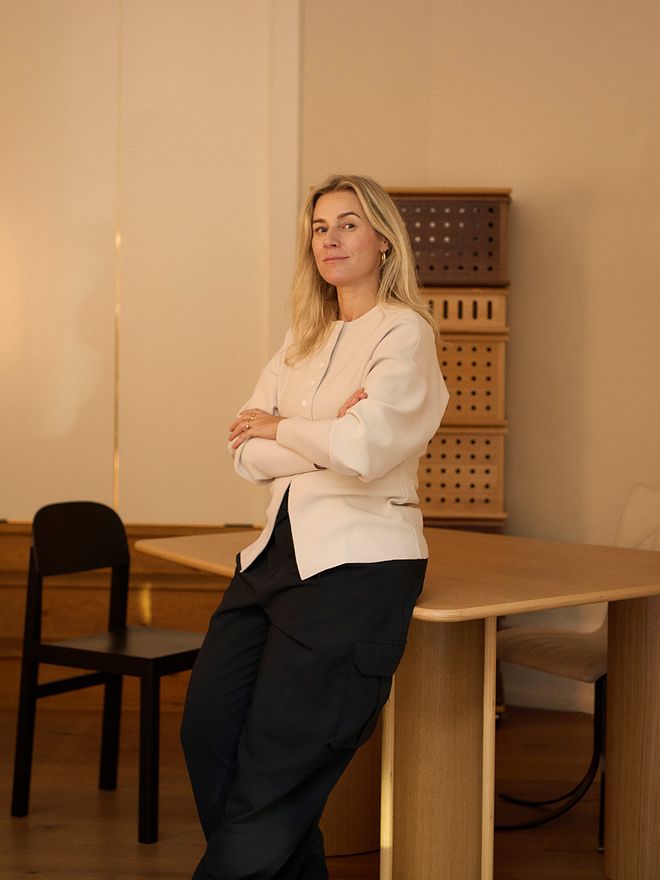
Designer Maria Bruun in her Copenhagen studio.
MARIA BRUUN’S Re-Norm table starts with a shift in perspective. Its soft asymmetry moves away from rigid geometry, proposing a different way of gathering that fits changing norms.
Working at the intersection of art, craft, and industrial production, Bruun approaches furniture as both concept and framework, objects that hold ideas while also shaping everyday life. Re-Norm reflects that position. Here, she shares the thinking behind the design and how it came to take form.
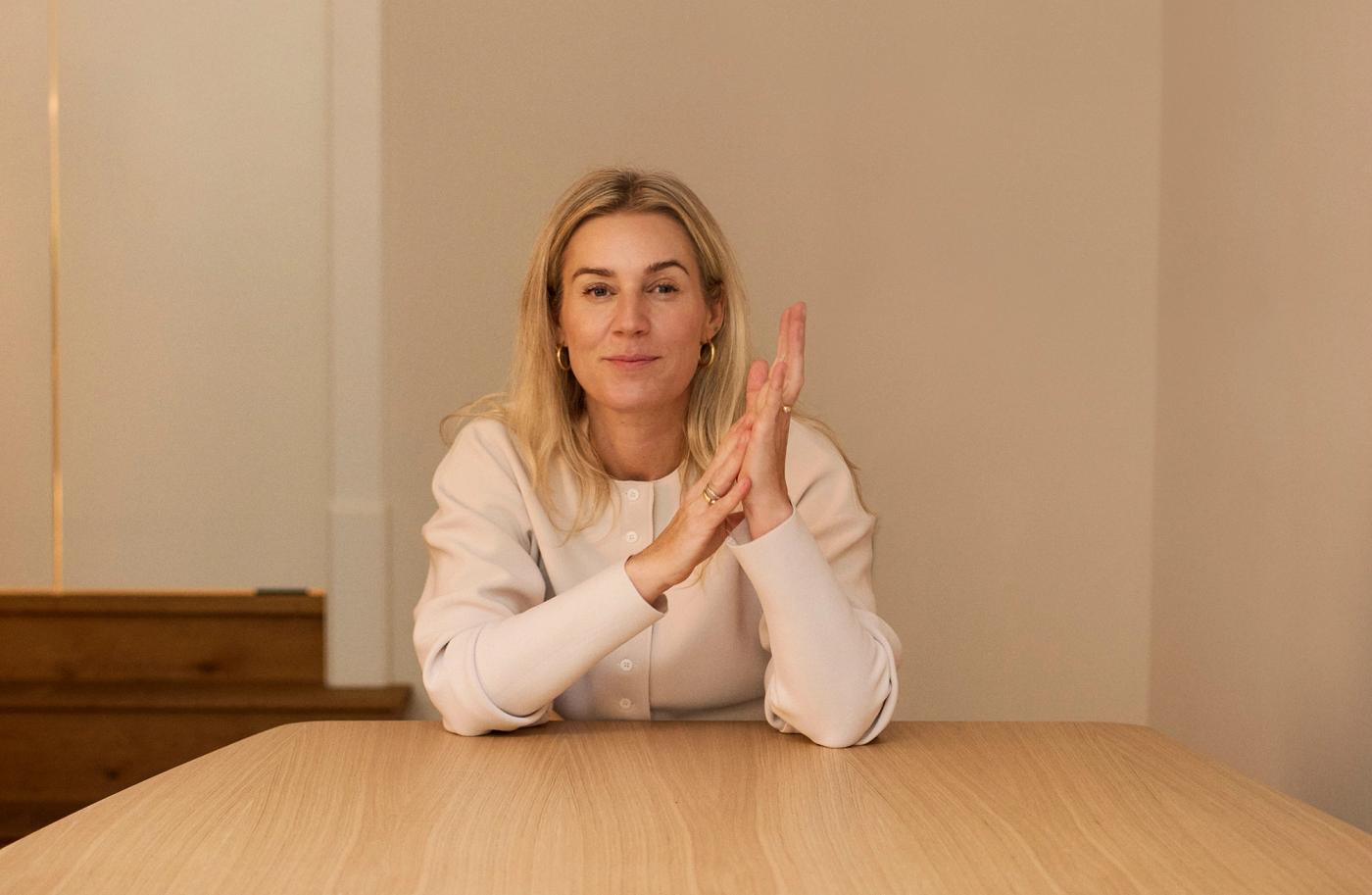
Maria Bruun graduated from the Royal Danish Academy of Fine Arts in 2021.
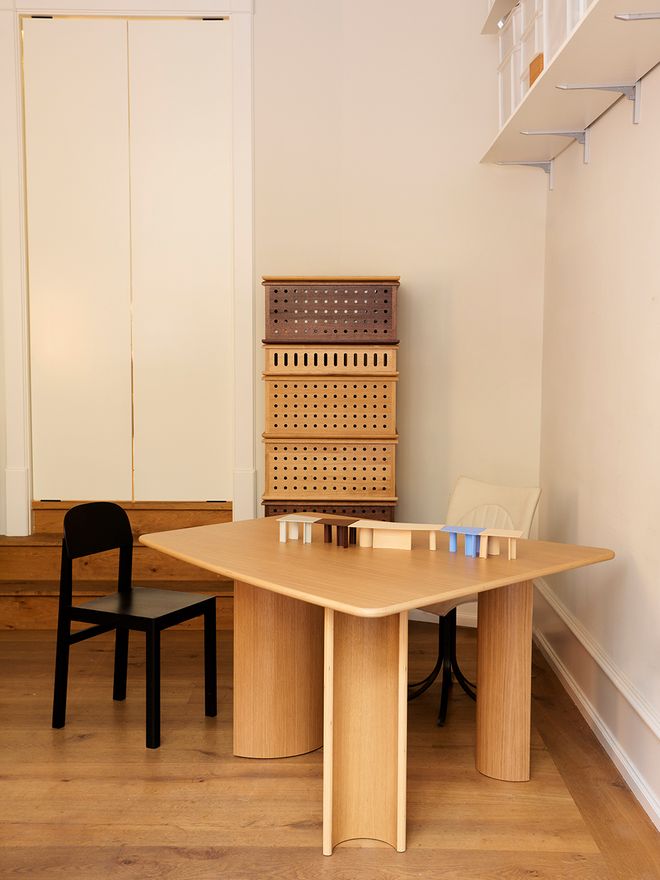
She designed the Re-Norm table for Muuto.
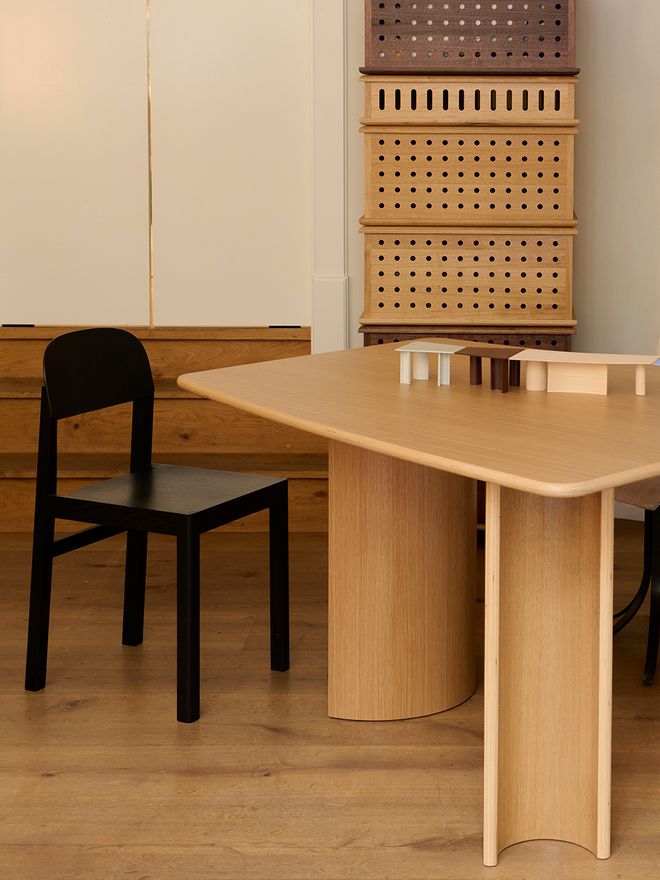
The curved edge changes how people face one another around the table.
Together with Muuto, we visited Maria Bruun in her studio in Østerbro, Copenhagen, a bright space where large windows fill the room with daylight and illuminate prototypes, material samples and working sketches. At the center stands Re-Norm in oak. Its sides are slightly uneven, and as you move around it, the geometry gradually shifts. From above, the form resolves into a sail-like silhouette.
Sitting along the table’s softly curved edge, something feels slightly different. The angle changes how we face one another, influencing posture, eye contact, and the flow of conversation, gently shaping the interaction without directing it.
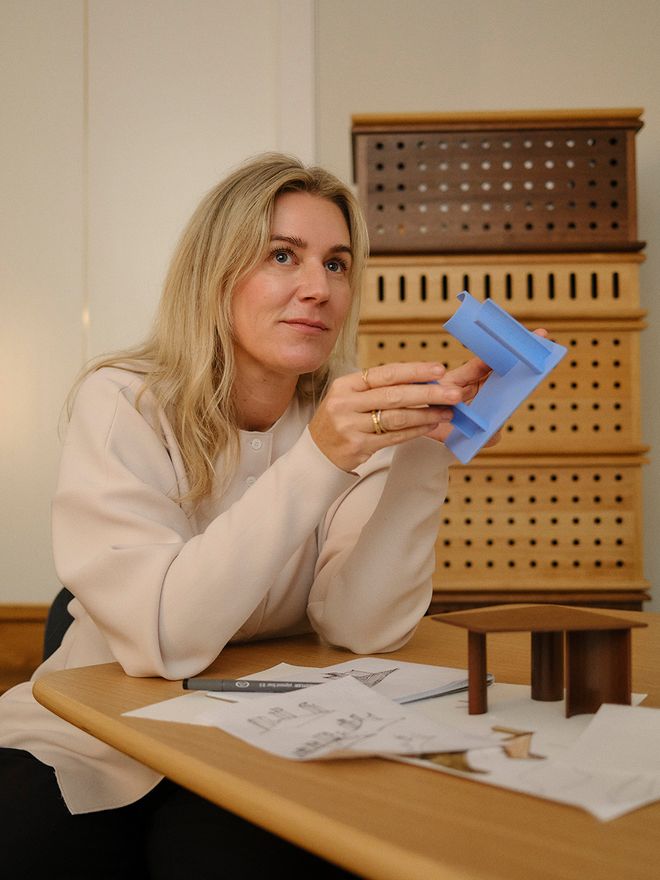
Alongside oak and walnut, Re-Norm is also available in blue, a color that highlights the table’s shifting geometry and sense of movement.
Trained at the Royal Danish Academy in Copenhagen, Maria Bruun established her studio in 2012. From the outset, her work has moved between gallery pieces and industrial production – less as a strategy, more as a reflection of her curiosity. That duality still defines her practice today.
Experimental works offer space to explore ideas, while collaborations bring them into everyday life. “I need both,” she says. “The conceptual freedom, and the reality of creating something people actually use.”
Re-Norm grew from that balance. As a starting point, Bruun looked at contemporary rituals: how we sit, gather and share space today.
“I wanted to question what we define as normal,” she explains. “The way we gather and position ourselves is far more fluid than we tend to assume.”
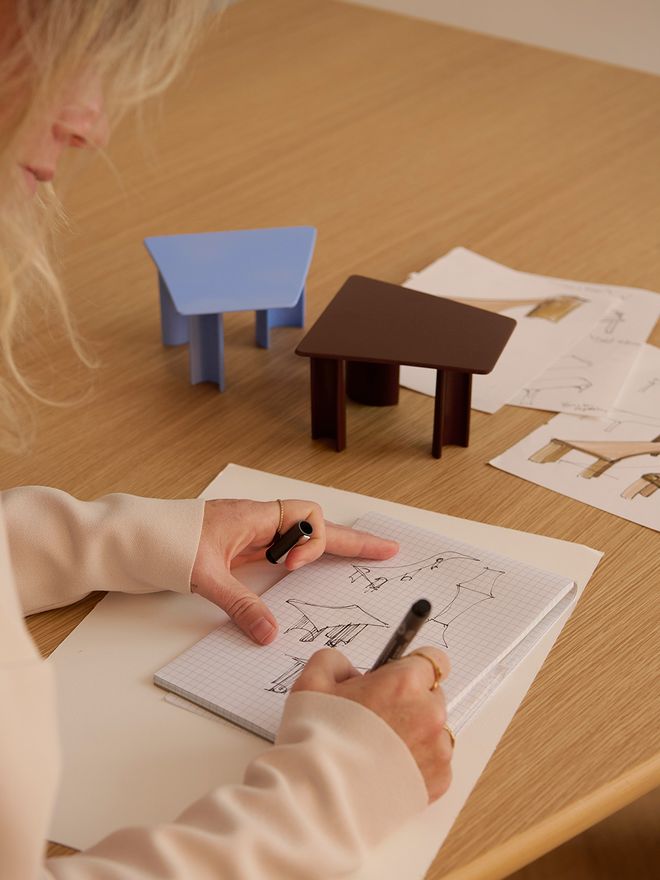
Small-scale models were used to study the table’s shifting geometry and proportions from different angles.
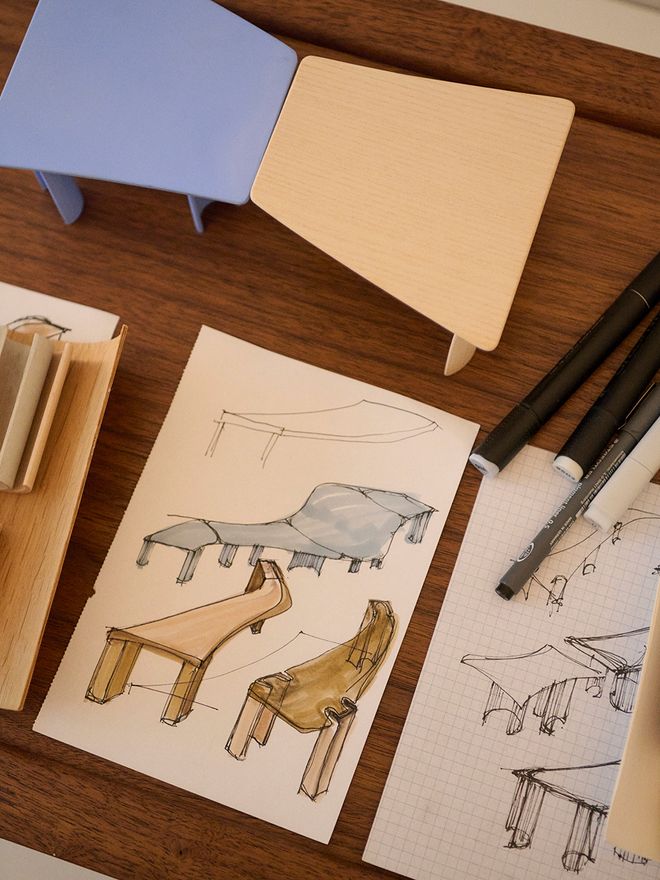
Early sketches explored an exaggerated taper, a conceptual starting point that gradually evolved into the final design through collaboration with Muuto.
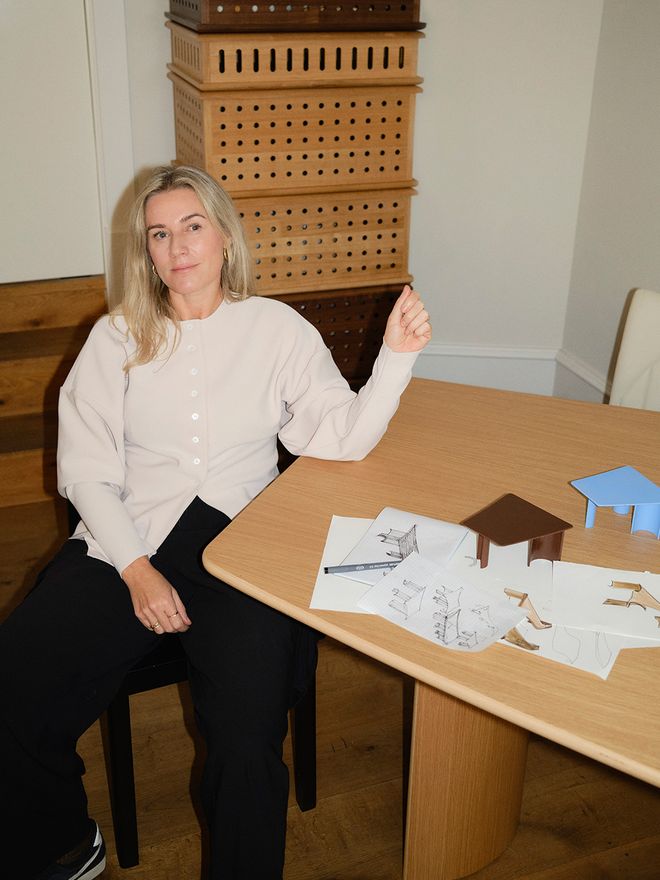
In her studio, Maria Bruun works at the intersection of concept and function, moving fluidly between experimental and production pieces.
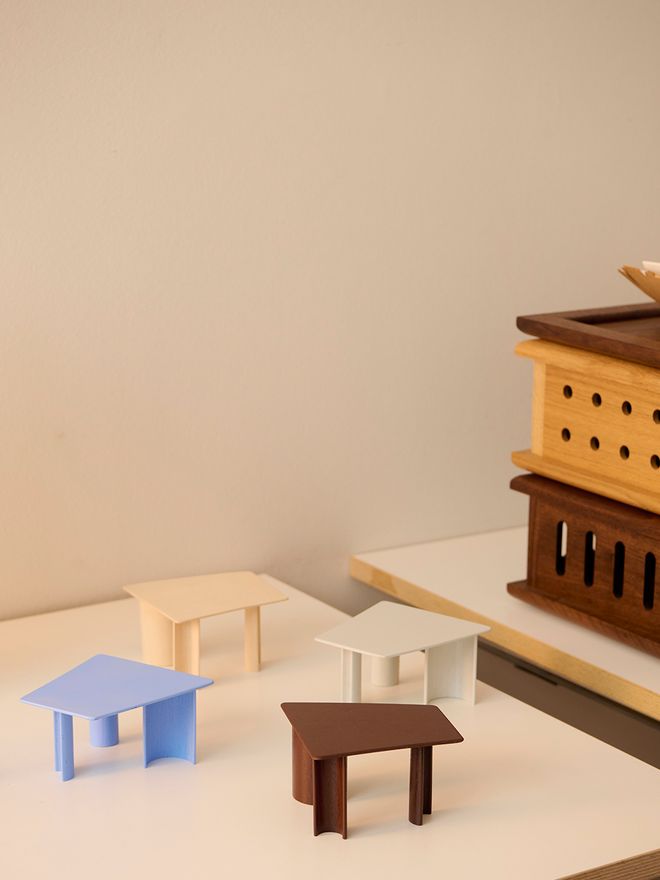
Working with scale models allowed Bruun to refine the balance between expression and functionality.
Bruun’s first sketches of Re-Norm were poetic and deliberately exaggerated. The tabletop narrowed dramatically toward one end, as if dissolving in perspective, until it could hold little more than a single vase. “It was very conceptual at first,” she recalls.
Through close dialogue with Muuto’s team, that expressive gesture was gradually translated into a functional design. The sharp taper softened into a gentle curve. The sculptural legs were adjusted and refined. Chair spacing and legroom were carefully studied.
What began as a formal exploration evolved into a table made for everyday use, while still challenging established formats. Instead of reinforcing convention, Re-Norm proposes a more unstructured and inclusive geometry for gathering. For Bruun, this adjustment reflects the way we gather today.
“We don’t sit strictly opposite each other anymore,” she explains. “Our way of gathering is more diagonal, more fluid, both at home and at work.”
The rituals around the table have evolved, as dining overlaps with work, studying, and social gatherings and its form follows that shift. The name suggests a reconsideration of the norms that have long shaped how we sit together. Where traditional tables are built on symmetry and hierarchy, with defined head positions, evenly spaced seating, and an implied order, Bruun offers something more fluid.
The asymmetrical geometry, with sides of different lengths and no fixed orientation, gently dissolves those structures. There is no single “right” seat and no prescribed arrangement, only the freedom to sit closer or farther apart, to cluster informally.
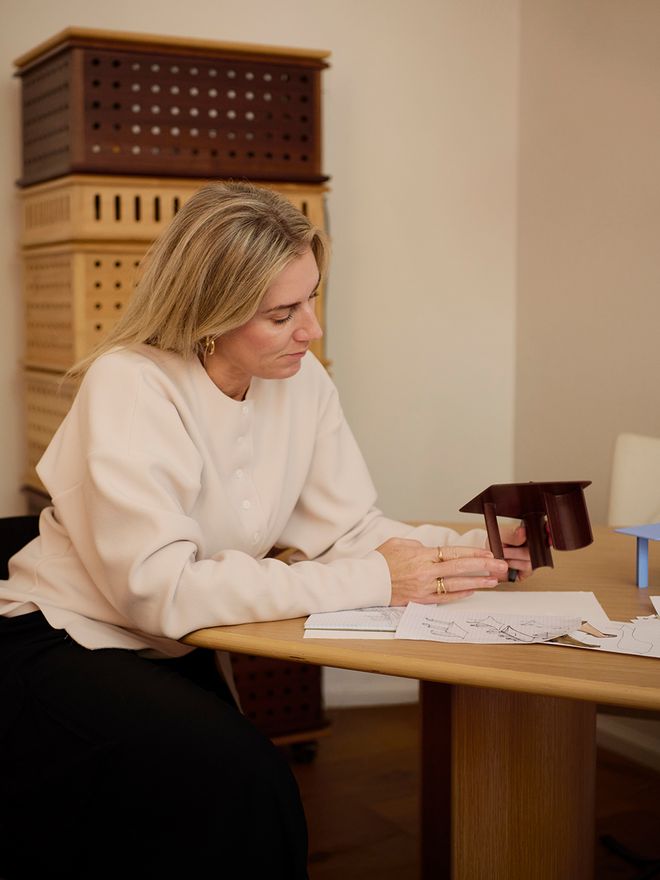
Beneath the tabletop, curved arches support the veneer construction. It’s a structural detail Bruun refers to as “the smile”.
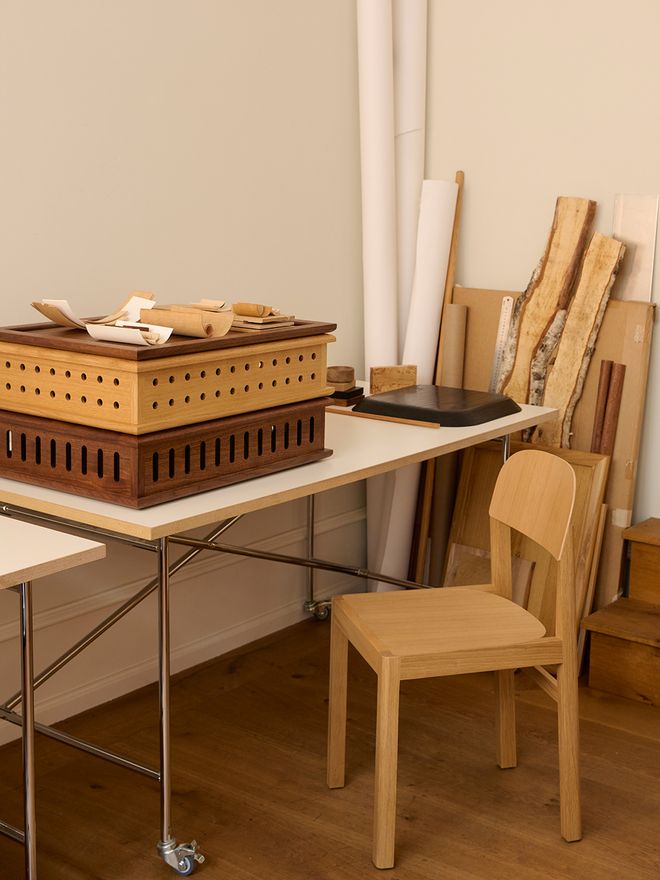
Prototypes, sketches and material samples fill the studio, offering insight into the development of Re-Norm.
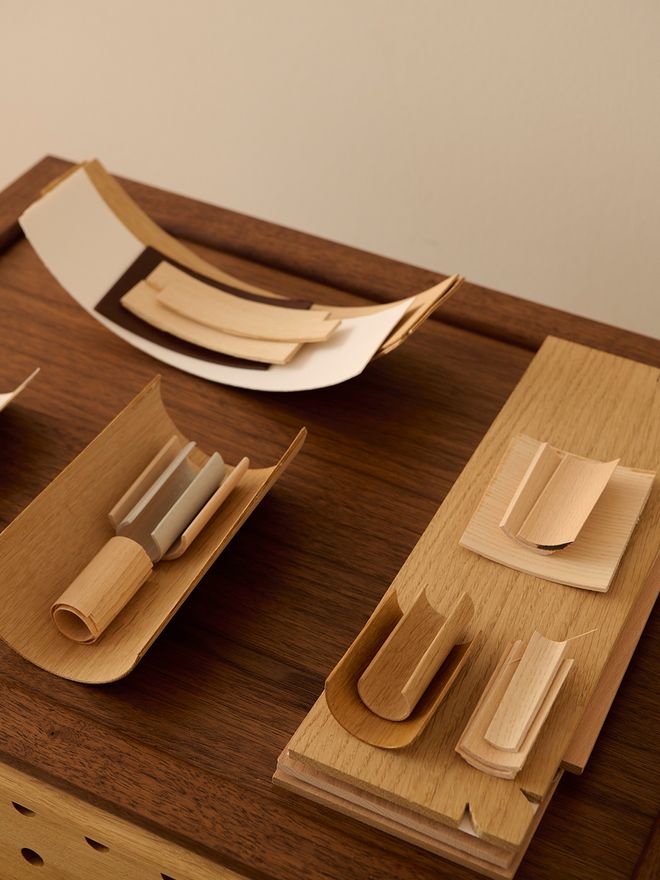
A selection of wood and veneer samples reflects the careful consideration behind the table’s material palette.
Materiality shaped the project from the beginning. Bruun chose veneer over solid wood, working with pressed veneer construction as both structure and expression. Beneath the tabletop, curved arches support the surface, a detail she refers to as “the smile.”
“The smile rationalizes the veneer,” she explains. “It makes the construction visible. We don’t hide the layers, we acknowledge them.”
Alongside oak and walnut, the table is also available in blue, a color that emphasizes the shifting geometry and highlights the design’s sense of movement.
Growing up in Denmark, Bruun was immersed in a culture where design is closely connected to everyday life. Within that tradition, she sees Re-Norm as a response to contemporary ways of living.
“The fixed way of living can feel less relevant today,” Bruun says. “This table responds to how we live now.”
See also:
• All designs by Maria Bruun >
• All products by Muuto >
Published on 17 Mar, 2026