Calm, creativity, and beauty in Milla Vaahtera’s 1950s wooden home
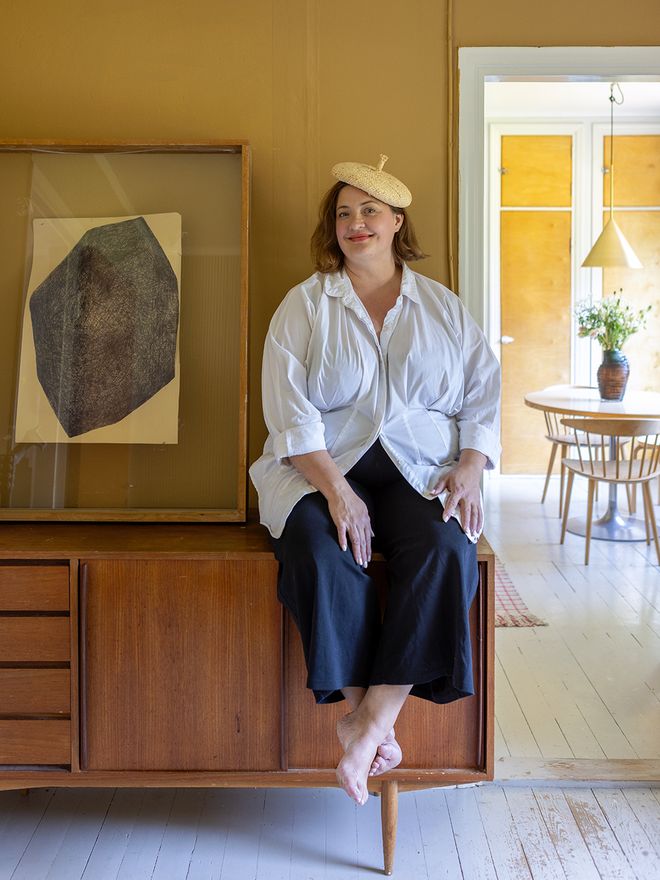
Milla Vaahtera loves flowers above all else and dreams of growing even more of them in her own yard.
ROOM TO EXPAND and spread out – that’s what artist Milla Vaahtera, known for her mobiles, stabiles, and lighting pieces in glass, had been craving. She was living with her partner Markus and their two children in an artists’ house in Vuosaari, in Eastern Helsinki, where a small workshop was attached to their home. While the baby napped and their eldest was at daycare, Milla would slip into the studio for short bursts of work.
Although the sea and sandy beach were just a stone’s throw away in Vuosaari, the idea of living surrounded by nature became increasingly appealing. The right home appeared in the form of a post-war detached house in Porvoo, about a 50-minute drive east of Helsinki. Next to the house lies a small forest, with tall trees shading the yard and nature and sky filling the views from the windows.
“A local lady told us that all the houses in this area were built with borrowed money in the 1950s. The neighborhood is called Velkala, a name that literally means ‘Debtville’ in Finnish. This particular house was built by a construction worker for his family, and we’re only the third owners. It was originally a working-class neighborhood, which feels familiar to me – I’m the child of a gold- and silversmith. The large garden, trees, and plants give me a sense of security,” Milla says.
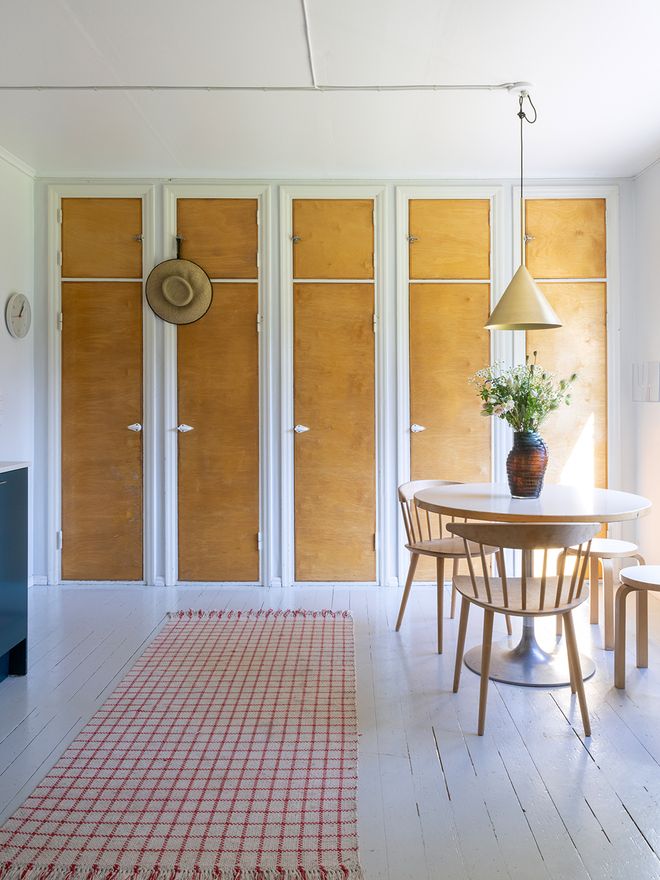
The home’s original elements, including the kitchen cupboards with their handles, charm Milla and Markus. The round table was found secondhand, and the J104 chairs around it are by HAY. The vase was designed and made by Toivo Molin.
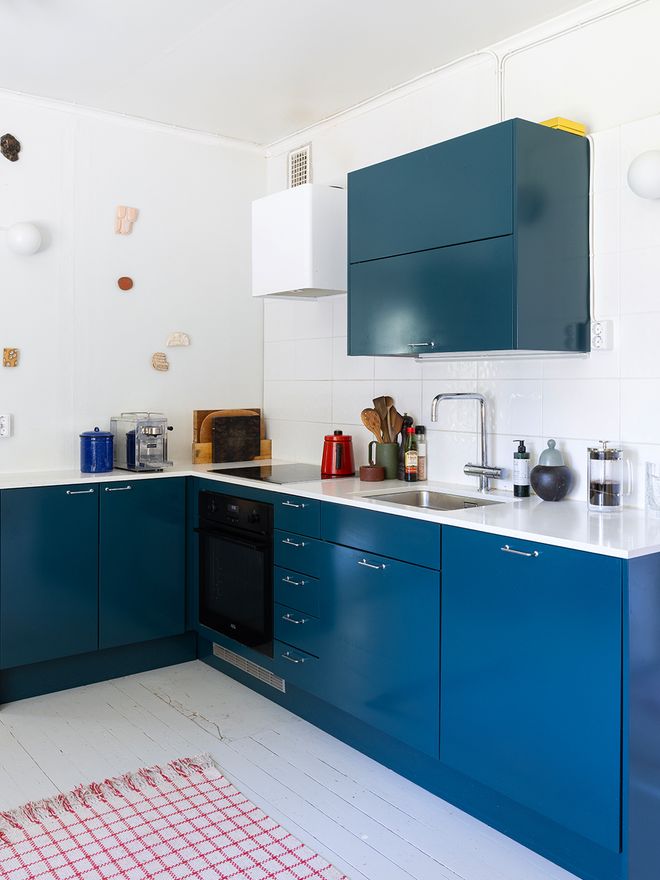
The petrol-blue kitchen cabinets were chosen by the previous owners and remain a highly functional solution.
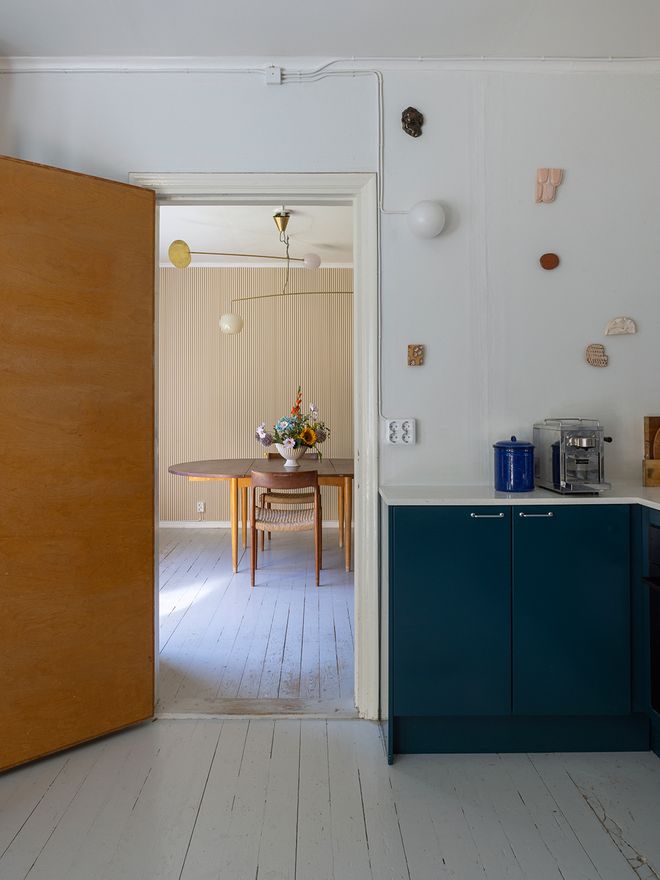
On the kitchen wall hang small ceramic works by Laura Pehkonen.
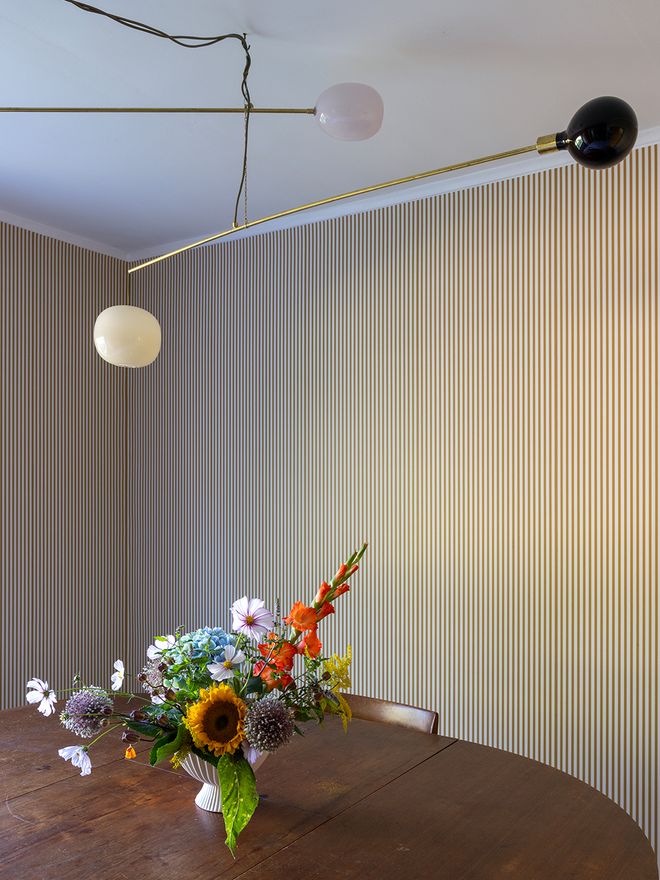
The dining set once belonged to Markus’s grandparents and was purchased from Artek in the 1960s. Hanging above it is Milla’s Sculptural Light No. 90. The striped wallpaper is from Sandberg’s collection.
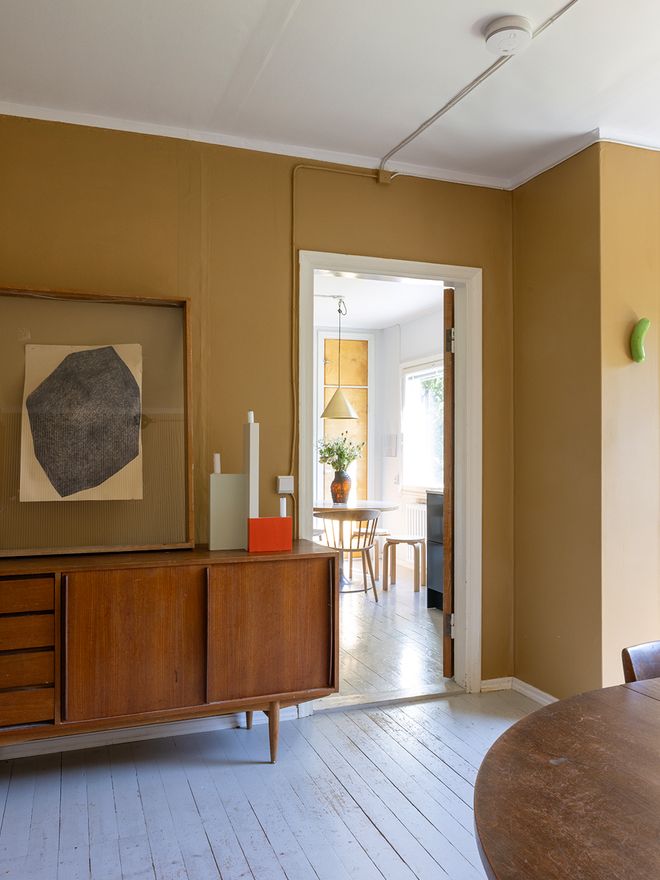
The sideboard, also from Markus’s grandmother, was bought from Artek in the 1960s. One of Milla’s drawings is framed in a frame made from an old door. The candleholder is by Hanna Anonen.
The idea of living in a post-war house appealed to Milla and Markus. There’s something nostalgic and instantly recognizable to Finns about these homes built after the war. The paneled walls and door handles feel familiar even to those who have never lived in one.
“Post-war houses are practical and iconic, but never showy. They’re modest in their own way, yet beautiful. In this house, we were charmed by the many original details that had, fortunately, been preserved. Sadly, in many older houses, these elements have been removed during periods when the architecture wasn’t in style. The original cabinet doors and handles, the moldings, and the worn softwood floors were all reasons we decided to buy the place.”
“Post-war houses are practical and iconic, but never showy. They’re modest in their own way, yet beautiful.”
The home had been well cared for and tastefully renovated by the previous owners. They had even installed traditional paperboard lining on the walls and ceilings, something for which Milla is forever grateful. All she and Markus needed to do was renovate the bathrooms, update the electrics, and wallpaper the walls, choosing wallpapers largely with art in mind.
“I’ve made unusually neutral choices for the walls, at least for me, because I want the artworks in our home to take center stage. My work is colorful, and I’m such a colorful person myself that I crave a calming atmosphere at home. I love color and go through strong color phases. Right now, I notice a literal red thread running through our interiors. But I don’t use red on large surfaces, because I have a feeling I’ll soon be in a completely different color phase, and red will be part of the past.”
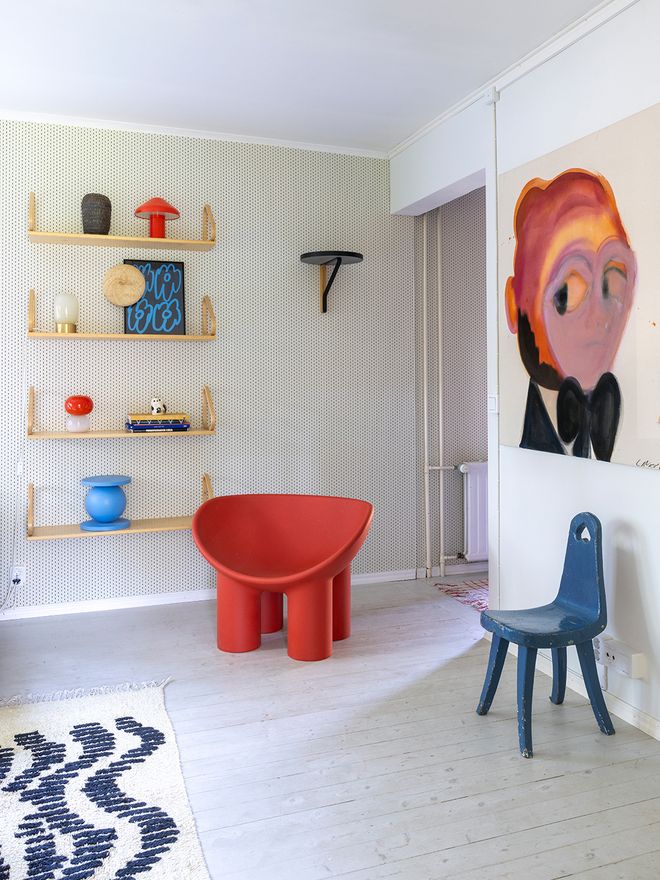
Color is deeply important to Milla. At the moment, a red thread runs through the home’s interiors. The Roly Poly chair was designed by Faye Toogood. On the Artek 112B shelves are, among other things, a painting and a flower stand by Hanna Anonen, a copper head sculpture by Laura Pehkonen, and a custom-made hat by Paula Kasurinen. The wallpaper is from Helene Blanche’s collection.
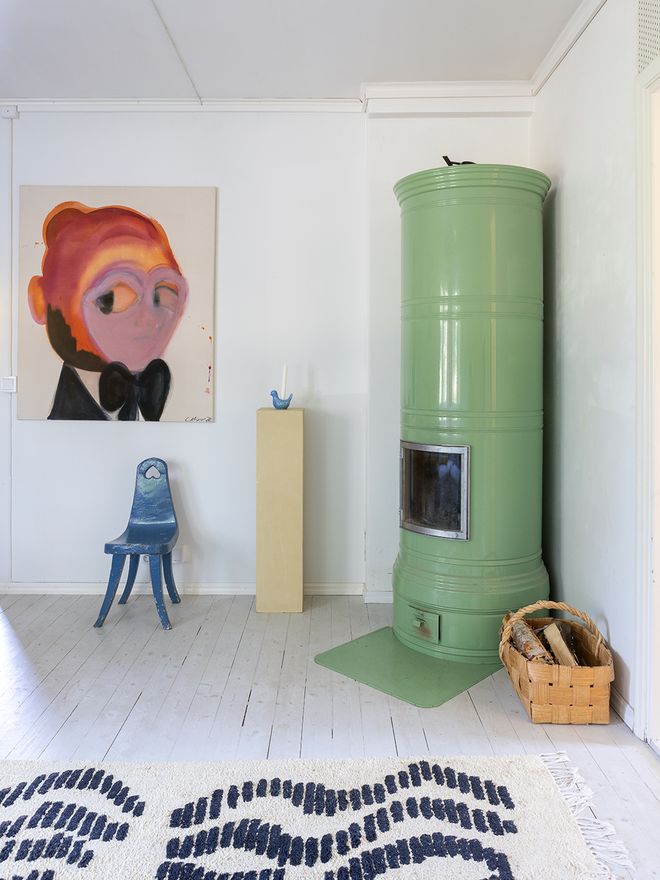
The Dyyni rug by Finarte was designed by Saana and Olli. The large painting is by Linda Linko.
This house offers space to create and to spread out, even into the yard if needed. Milla often photographs her pieces outdoors, and the presence of a large, old oak tree nearby helps convey their scale. Her workshop and storage are now located in the basement, but she dreams of turning the outbuilding into a studio. With a ceiling height of up to four meters at its highest point, it would easily accommodate large-scale works.
“Home has a huge influence on me as an artist. I need physical space in order to think, to envision big ideas and projects. Our home often hosts a rotating exhibition of my works in progress. When I hang a piece in the living room, for instance, I can quietly observe it over time. It takes both time and space for a work to take shape and reach completion. It’s important to be able to see it in a setting beyond the workshop.”
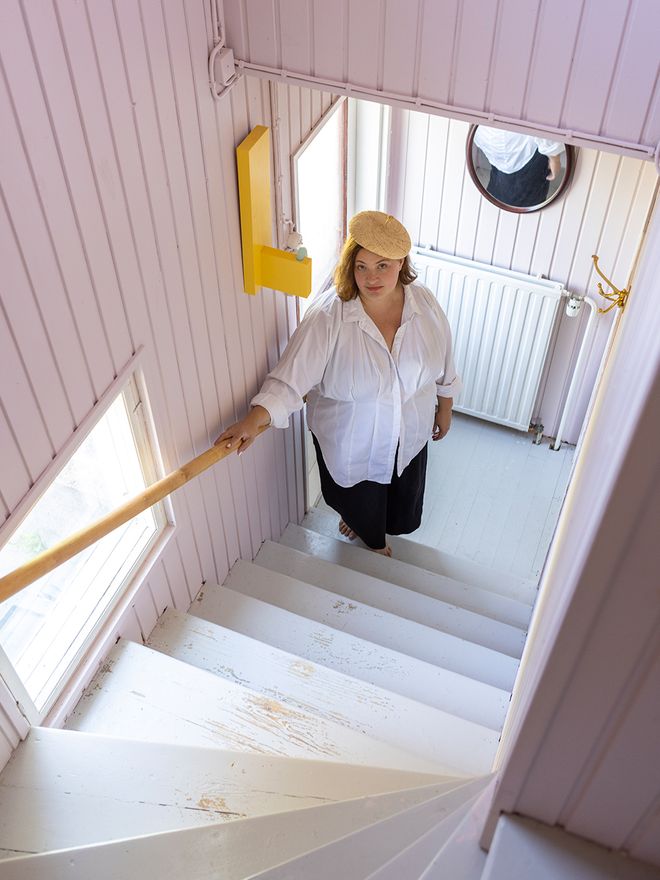
The staircase leading upstairs features original paneling, which Milla painted herself in a custom-mixed shade.
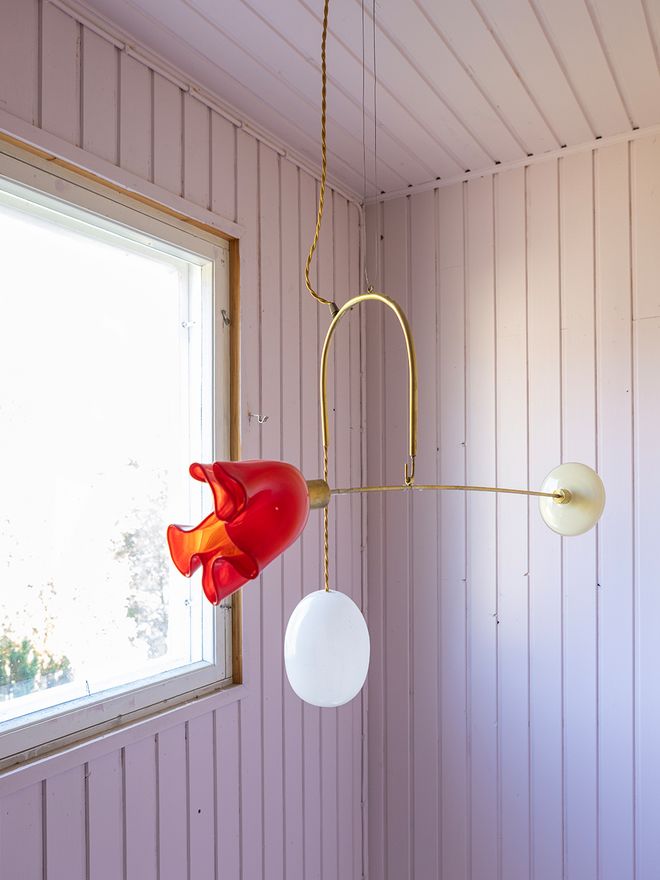
The stairway light is one of Milla’s own creations. Her mobiles and other works are available at Lokal Gallery in Helsinki.
Milla is especially drawn to creating works for public spaces. Such spaces are often newly built and lack the layers of history that give older environments their character. Hand-molded clay or mouth-blown glass can add a timeless quality that brand-new spaces wouldn’t otherwise possess.
“I’d like to do for Finnish art and craft what Paavo Tynell’s lighting once did. My dream is for handcrafted art to become a greater part of public spaces, whether in schools, libraries, or metro stations. If anything, public spaces are in need of the depth and soulfulness that craft can bring.”
“I’m like a magpie, I need beauty and art around me. It feels like we never have enough of it.”
In addition to her own pieces, the home holds a wealth of art created by Milla’s friends and acquaintances.
“I’m deeply in love with my friends’ style and expression. I’m like a magpie, I need beauty and art around me. It feels like we never have enough of it. There are so many artists whose work I dream about owning. For instance, I’d love to buy one of Armi Teva’s strange ceramic meringue pastries or quirky dogs, or one of Hanna-Kaisa Korolainen’s large wall hangings or dramatic ceramic sculptures.”
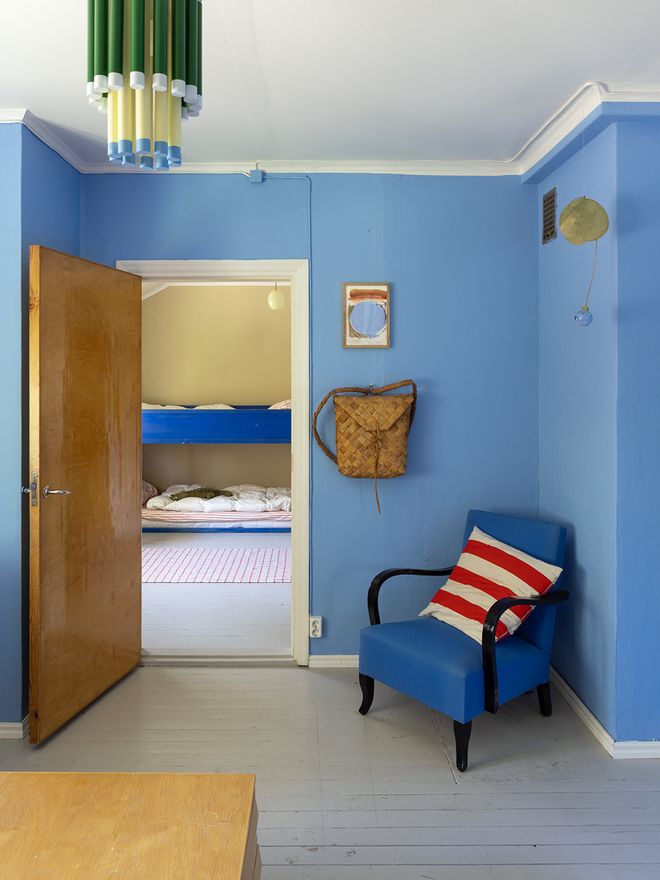
The upstairs landing is painted light blue in the shade Taivas by Tikkurila. The Cocktail light was designed by Milla’s close friend, designer Hanna Anonen. The chairs come from Markus’s mother’s childhood home, and the birch-bark backpack is a treasured heirloom. The small artwork is by Linda Linko.
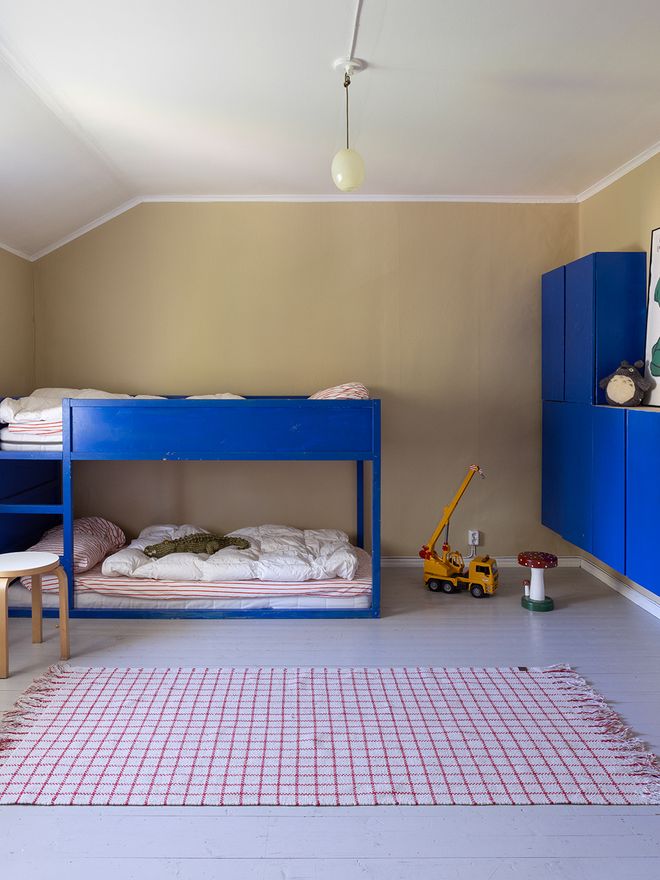
The bunk bed and cabinets in the children’s room are painted cobalt blue. Finarte’s Ruutu rugs can be found in both the kitchen and the children’s room. The wall color is Lakeus by Tikkurila.
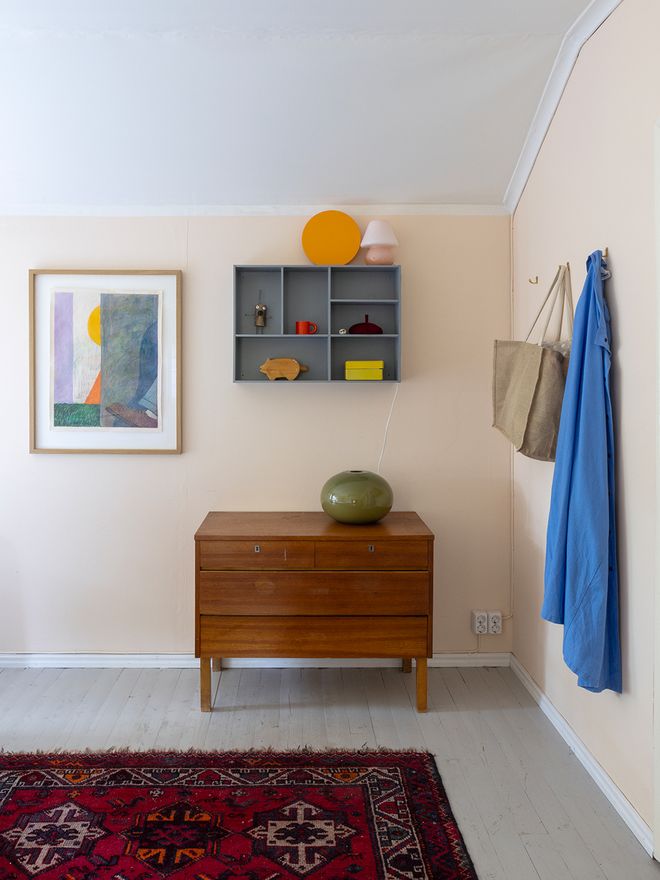
Milla has chosen unusually neutral wall colors so that the artworks stand out and take center stage. The piece on the wall is by Sami Havia. The glass sphere is made by Milla, and the table lamp is from Murano. The piggy bank was found at a flea market in Porvoo.
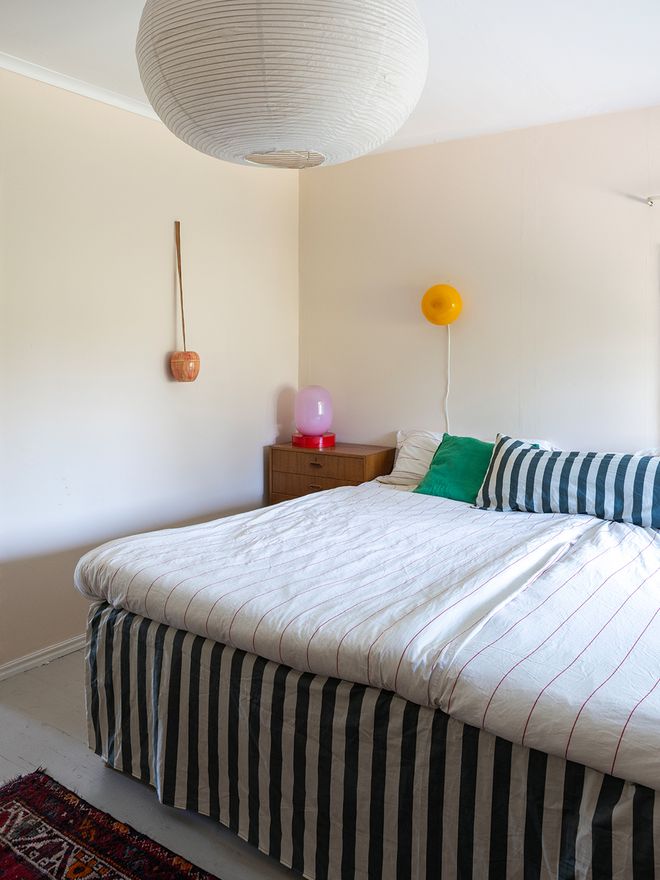
The family’s extra-wide bed fits everyone at once. Measuring 240 cm across, it was made by pushing three box-spring beds together. Hanging on the wall is a Company apple bag. The glass pendant lights are made by Milla, and the Paper shade is by HAY.
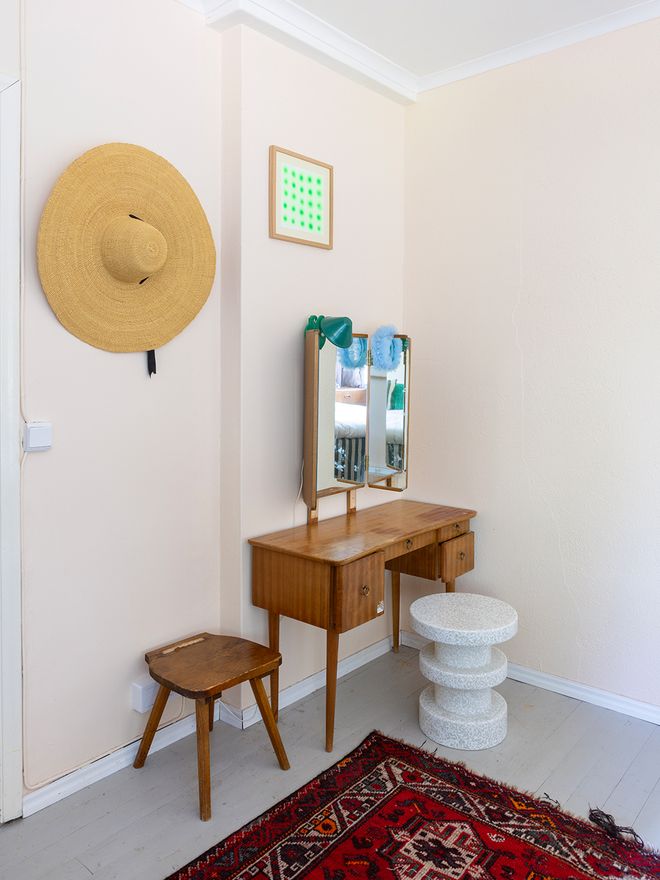
At the vintage vanity stands a Bit stool by Normann Copenhagen, made from recycled plastic.
Most of the home’s furnishings are inherited pieces. For instance, the dining set and sideboard once purchased from Artek by Markus’s grandmother bring depth, stories, and a beautiful patina to the interior.
“This is the first home we’ve truly decorated with our hearts. It’s our first owned home, after all. We’ve wanted it to be filled with objects we feel a special connection to, things that hold meaning for us,” Milla says.
“I’m an aesthete, and being surrounded by beauty calms me. What could be more important for a person’s well-being than beauty? In Porvoo, there’s an abundance of it. It feels almost miraculous that in the midst of everyday routines, I can experience so much beauty.”
See also:
• New arrivals at Finnish Design Shop >
This story was previously published in Asun magazine 1/2025. The featured products may not be available worldwide.
Published on 15 Aug, 2025