This is a carousel of product images. Use the thumbnails or swipe to change the displayed image, and activate an image to open it full screen.
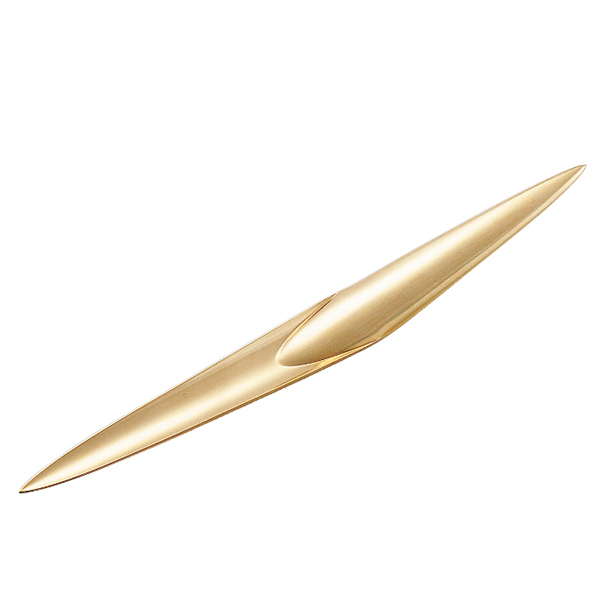
Paper knife, bronze
Description
The paper knife designed by Tapio Wirkkala in the 1970’s is the perfect example of Wirkkala’s deep understanding towards form, function and material.
- Length: 20.7 cm
- Material Bronze
- Product ID: KK776-122

Tapio Wirkkala (1915–1985) is one of the most significant Finnish designers, and his career symbolises in many ways the global success of Finnish modern design. Wirkkala was a versatile designer and artist whose work ranged from glass design to furniture, graphics and sculpture. Over the course of his career, he designed a wide variety of objects, from refrigerators to banknotes and from furniture to magnificent jewellery.
The most important materials for Wirkkala were wood and glass – he was constantly searching for new ways to use them. He is remembered above all for the glass objects he designed for Iittala, such as the Ultima Thule series.
Tapio Wirkkala – an interpreter of nature’s forms
Tapio Wirkkala is one of the most internationally renowned names in Finnish design. Having graduated as an ornamental sculptor from the sculpture department of the Helsinki Central School of Applied Arts in 1936, Wirkkala was in many ways self-taught, as a glass artist too. His career took off strongly in 1946, when he designed the Kantarelli vase for Iittala, which went on to become a classic.
Wirkkala’s international breakthrough came at the Milan Triennale in 1951, where he won three Grand Prix awards. Around the same time, he also served as artistic director of the Institute of Industrial Arts in Helsinki from 1951 to 1954.
Classics of Finnish glass art
The starting point of Wirkkala’s work was often the observation of nature’s structures. He studied the cracks of ice, the movement of water and the elements of the forest, and transformed these forms into objects in which asymmetry and randomness take on a central role.
Wirkkala’s first glass collection to reach serial production at Iittala was Tapio, from 1954. One of his best-known works is the Ultima Thule series, designed in 1968, whose glassware is made using a special ice-glass technique. The technique was born as a result of Wirkkala’s development work and brought the objects a nature-inspired texture reminiscent of an icy surface.
A shaper of Finnish modernism
Wirkkala’s career was exceptionally wide-ranging. In addition to glass, he designed furniture, sculptures, posters and everyday objects, and his handprint was also seen in the design of Finland’s currency. Over the course of his career, he was honoured with several significant awards, such as multiple top prizes at the Milan Triennale, the Pro Finlandia Medal in 1955 and the honorary title of Academician of Art in 1972.
Wirkkala was also a central figure in the rise of Finnish design to international awareness in the mid-20th century. His legacy lives on strongly both in objects still in production and in the mindset of Finnish design, in which the greatest source of inspiration is often nature.
Who: Tapio Wirkkala
- Finnish designer and sculptor (1915–1985).
- One of the most significant names in Finnish glass design.
- His design is marked by a sculptural aesthetic inspired by the forms of nature.
- Designed thousands of objects over his career, including around 400 glass objects for Iittala.
- Notable works: the Kantarelli vase, the Tapio glassware and the Ultima Thule series.
Design Stories: Read more and find inspiration
View all products5

Based on 3 reviews
-
A
Anonymous | Verified Customer
Toyama, JP

I like this paper knife design by Tapio Wirkkala. I can see powerful and dynamic shape which is a sort of his design's speciality. Off course, it is quite easy to open a letter. And the figure on the desk is very beautiful. Small thing but very conciderabled design with it.
1 year ago
-
A
Anonymous | Verified Customer
Namerikawa, Japan
It is Tapio Wirkkala's quite exllent design which is continuasly manufactured long time. I realy think what I could purchase such kind of item at the shop is very happy. His paper weight is exsist in past but not production at the moment. I hope exllent design collections should be continue from now on.
1 year ago
-
I
Isabel G | Verified Customer
Lisbon, Portugal
2 years ago
The Product Sustainability Framework, our criteria of sustainable design, helps you find the most sustainable products in our selection. Read below which sustainability criteria this product has met.
-
 Equal opportunities for all employees
 -
Commitment to UN Global Compact, fair compensation for all employees
-
Corporate responsibility requirements defined and communicated for suppliers
-
Systematic work for improved inclusion and well-being in the workplace
-
Transparent supply chain
-
Compliance to the UN Guiding Principles on Business and Human Rights ensured in the supply chain
-
Suppliers' compliance to a code of conduct ensured
-
Direct suppliers audited and certified
-
Support for community involvement in the supply chain
-
Fair and resource-wise water-use in production
-
No incineration or landfilling of returned items
-
No use of endangered species as materials
-
No direct environmental emissions or waste (excl. GHGs) from production
-
The sustainability of direct suppliers' production is addressed and monitored
-
Production and material sourcing that respect biodiversity, animal rights, and natural ecosystems
-
Material-efficient and ecological packaging
-
No potentially harmful chemicals used in own production
-
Positive impact on nature’s well-being through operations that regenerate natural ecosystems
-
Company's direct greenhouse gas emissions identified and commitment to reduction
-
Product's carbon impact identified and commitment to reduction
-
Guidance on energy- and eco-efficient use of the product
-
Contribution to climate initiatives beyond the brand’s direct operations
-
Low-carbon or compensated transportation
-
Carbon footprint of the product calculated and goals set to reduce it
-
100 % renewable energy in own production and operations
-
Carbon neutral or carbon negative product
-
Sustainable and long-lasting material choices
-
No harmful or hazardous substances
-
Responsible raw material sourcing and production
-
Materials suited for circularity: monomaterials, recyclable finishings, renewable or recycled contents etc.
-
Ecological materials: natural, biodegradable, recyclable or recycled contents
-
Outstanding materials in terms of innovativeness, responsibility, sustainability and circularity: local production or sourcing, 100 % recycled content, C2C-certification etc.
-
High aesthetic quality promoting long-term use of the product
-
Technically durable product design and material choices
-
Design for enduring life-long quality
-
Design and support for product maintenance, repair and upgradability
-
Innovative circular design solutions: circular service system, resale platform, remanufacturing, collection of used products, etc.
Ideas and inspiration
This is a carousel. Use Next and Previous buttons to navigate.