Marimekko’s beloved prints come to life at its own textile printing factory
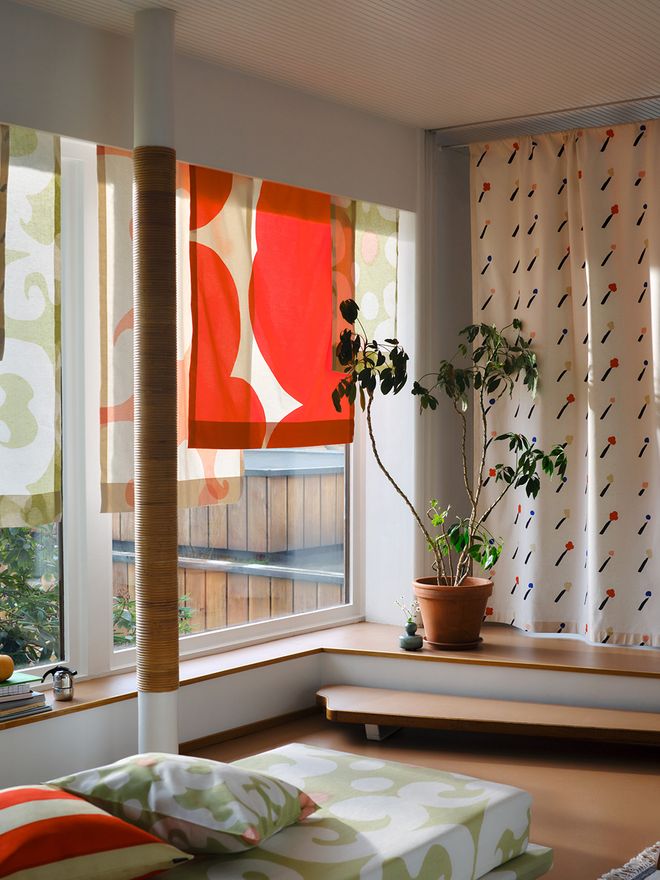
Prints and fabrics from Marimekko’s Spring/Summer 2026 collection. Photo: Mikael Niemi.
Hi Minna! Could you tell us a bit about your role at Marimekko?
“Hi! I’m Marimekko’s Design Director, Home & Print Design. My work includes leading the design of Marimekko’s home collections, developing new prints together with our print designers, and bringing archival prints into our collections.”

Minna Kemell-Kutvonen is Marimekko’s Design Director, Home & Print Design.
Having its own textile printing factory is rare on an international scale. Why is it so important to Marimekko, both from the perspectives of creative work and production?
“Our distinctive and internationally recognized print art is what sets us apart from every other brand. Our archive includes more than 3,500 prints, and new designs are created every year. At the heart of it all is our textile printing factory in Helsinki. It is one of the few industrial-scale textile printing factories in the Nordics.
“Printed fabric and the design expertise connected to it have always been at the core of our brand – its soul and heart.”
New printed fabrics and the products made from them are created through close collaboration between professionals from different fields, and it is important for our designers to work close to production.
In addition, the printing factory serves as an incubator for print expertise and innovation. Having our own factory also allows us to actively participate in research and development projects. We collaborate with various companies and partners in the field of material innovations, for example by enabling the testing of new fabrics, dyes and coatings at our textile printing factory in Helsinki.”
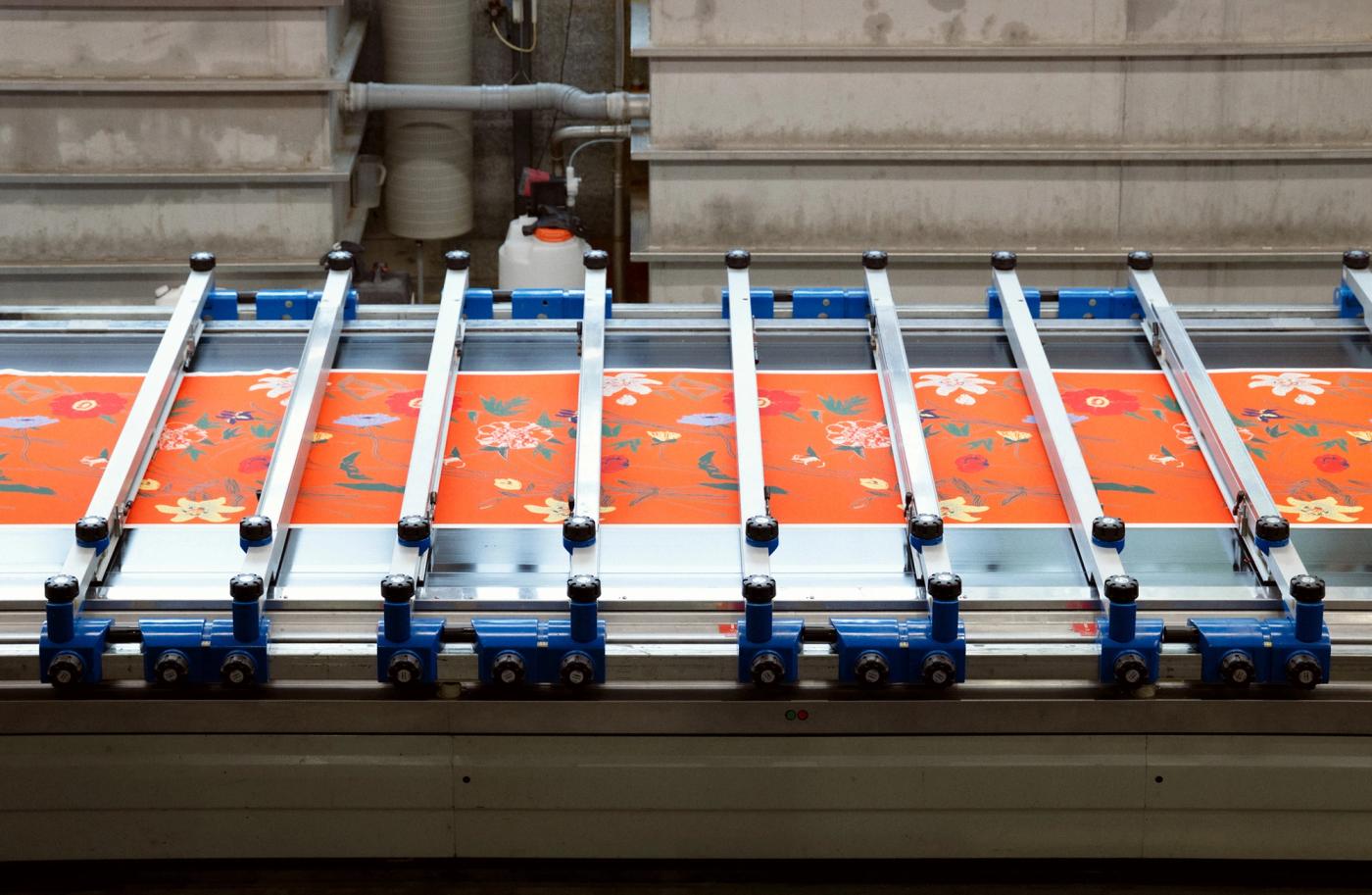
Flowers bloom across the colorful Puutarhakutsut print, designed by Fujiwo Ishimoto in 1989.
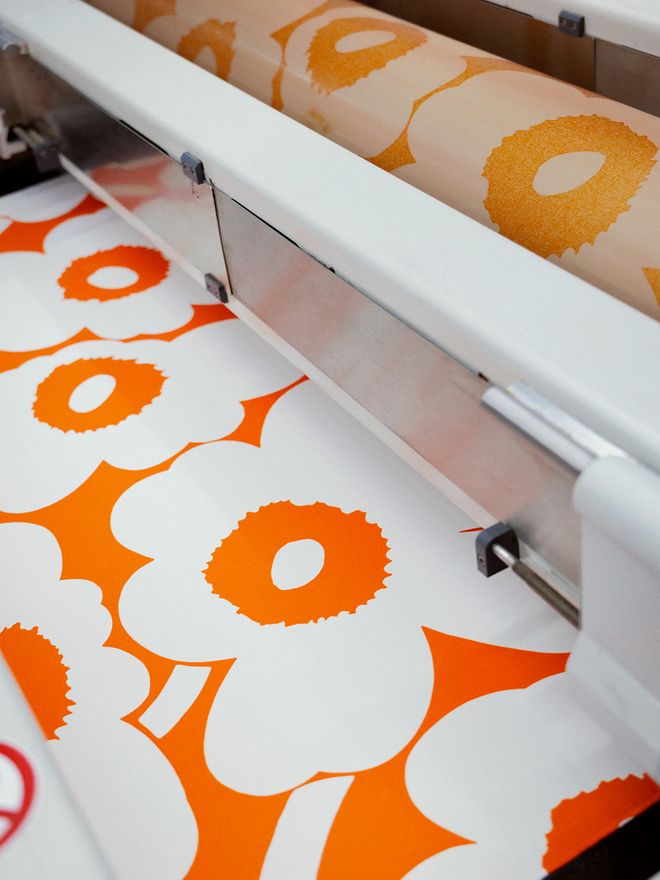
“The printing machines are stopped immediately if the print doesn’t look exactly right,” says Kemell-Kutvonen.
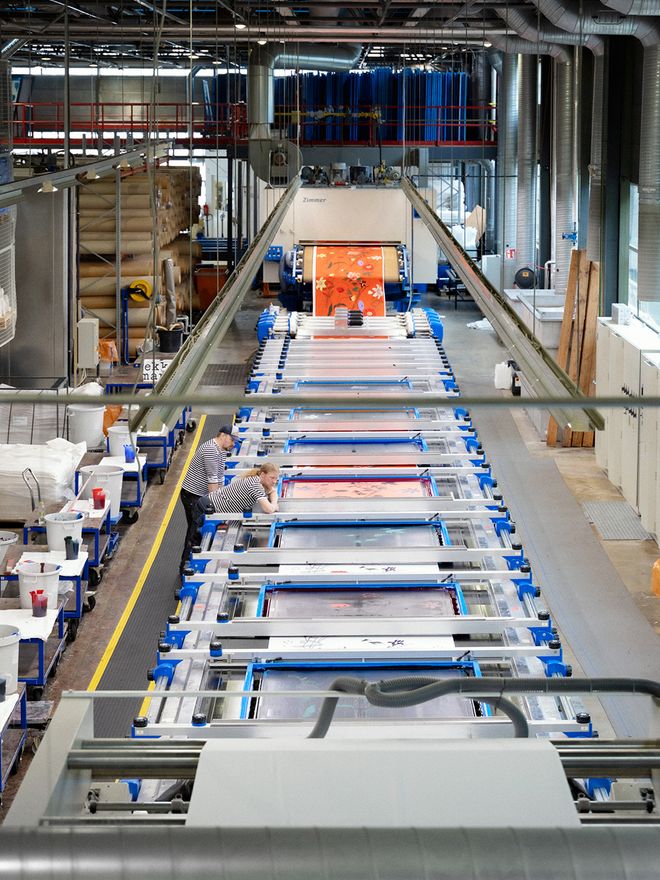
In flatbed printing, color is manually applied onto the printing screen.
What happens at the textile printing factory during a typical workday?
“Our own textile printing factory is the heart of Marimekko’s print design and the place where our bold colors and prints come to life. It is located in the same building as our headquarters and serves as a creative hub where designers work in close dialogue with printing professionals to bring unique print art onto fabric.
On a typical workday, one – or both – of our printing machines are running, printers flick color onto the screens with a light movement of the wrist, dyes used in the printing process are mixed in our color kitchen, and our design team visits the patch library at the factory to select colors while working on upcoming collections.
The factory uses both flatbed and rotary printing techniques. Rotary printing is particularly well suited to smaller, densely repeating patterns, while flatbed printing works best for large-scale, architectural prints. One thing Marimekko is known for is the overlapping of colors during the printing process. This is used in many prints and creates surprising, sometimes even unpredictable shades and tones within the pattern.”
What surprises visitors to the textile printing factory every time?
“First of all, the fact that we have an industrial-scale textile printing factory in Helsinki, right next to our headquarters. And of course the sheer amount of fabric we print. Around one million meters of fabric are printed at our Helsinki factory every year.
The printed fabric is used across all three of Marimekko’s product categories: fashion, bags and accessories, and home products.”
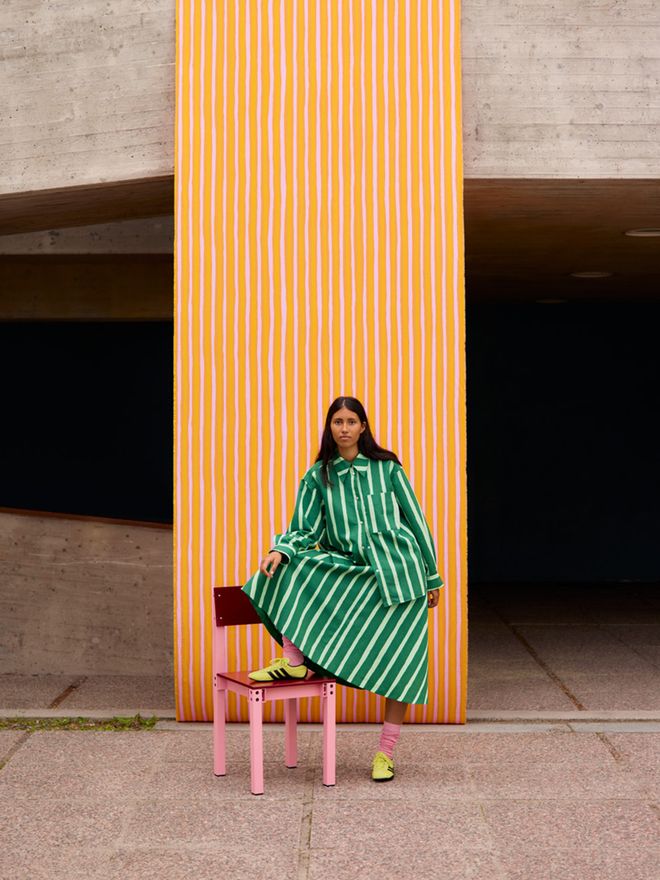
The fabrics printed in Helsinki are used in everything from Marimekko home textiles to fashion. Photo: Mikael Niemi.
You already mentioned Marimekko’s vast archive of more than 3,500 prints. What kinds of technical or artistic challenges are involved in printing these archival designs onto fabric?
“Large areas of color and the overlapping of multiple printing colors can be challenging to achieve. A good example of a print with large, gradient-like color surfaces is Selänne, designed by Fujiwo Ishimoto in 2003 and inspired by the way the colors of a landscape shift throughout the day.
We solve these kinds of challenges through close collaboration between our broader design team, our drawing studio, and the professionals working at the printing factory. This is possible because the factory is located in the same building as our headquarters.”
How does an entirely new print move from a designer’s idea to printed fabric?
“Our design process always begins with the theme of the year, a specific collection theme, or the concept behind a project. This year’s overarching theme is ‘Art of Printmaking,’ celebrating the art, science, and craft of printmaking. Our print designers are always given a brief connected to a certain collection theme or project, while still having room to use their own creativity. Sometimes the brief is based on both theme and technique, while at other times we provide only the theme. It depends on the situation.
“Each print designer has their own preferred form of expression, and we want to leave plenty of room for that. That’s where the artistic value comes from.”
Our role within the design team, the drawing studio, and together with other specialists is to find the best possible ways to bring the designer’s idea to life.
In connection with a collection theme or project, we also often select prints from Marimekko’s archive. The print stories of different collections are usually built from a combination of new designs and archival treasures.
Once a print has been designed and its intended use, materials, and applications are known, its journey toward the printing process begins.”
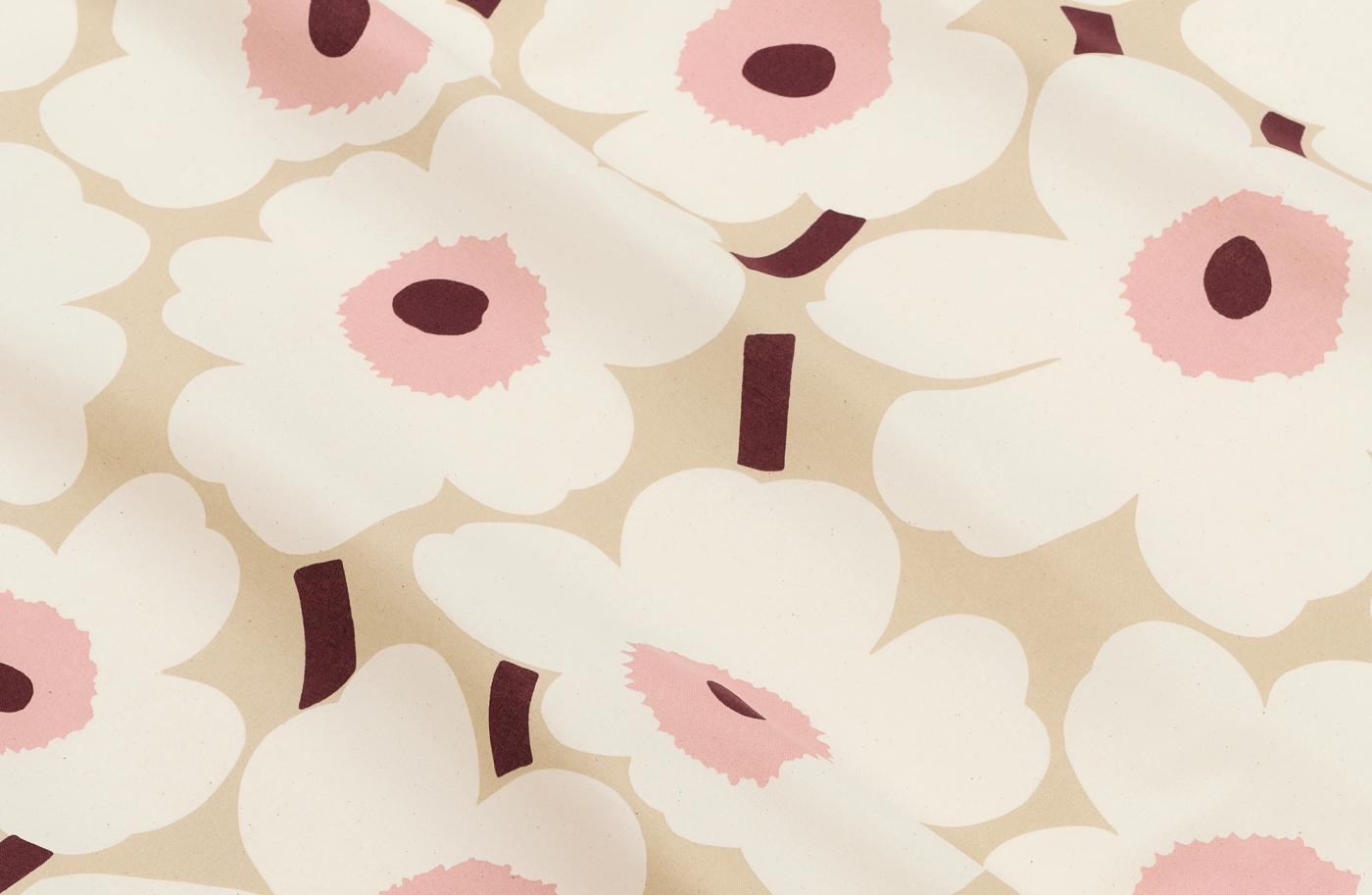
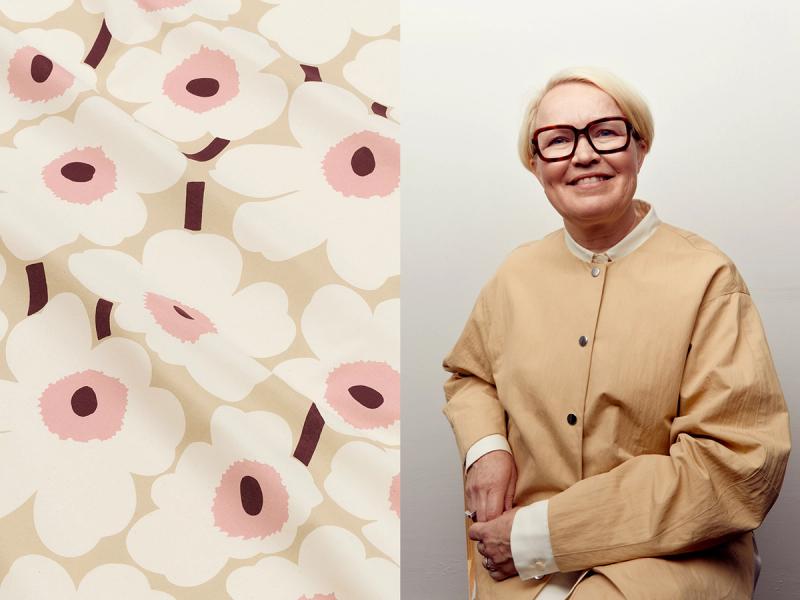
Maija Isola’s iconic Unikko print from 1964 appears on everything from bedding to home textiles.
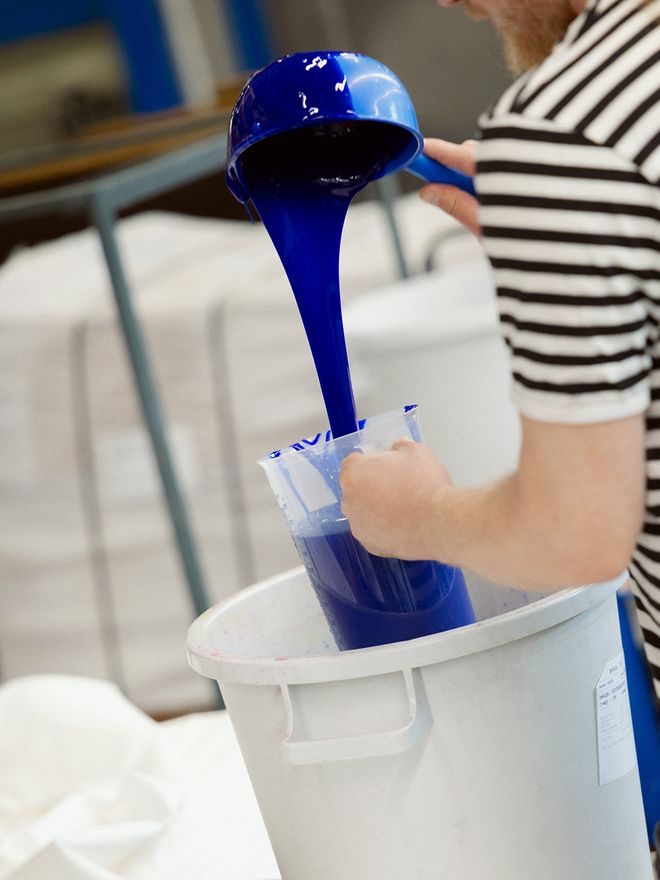
Fabric printing still involves a great deal of craftsmanship, and many of its techniques can only be learned through hands-on experience.

Marimekko’s archive contains more than 3,500 prints. Alongside them, new designs are created every year.
There is a great deal of craftsmanship involved in Marimekko’s printing process, even though the actual printing is done mechanically. At which stages are the human eye, hand, and experience still irreplaceable?
“Marimekko’s print art is exceptional even on a global scale, and every product reflects world-class expertise in its field. The imprint of human hands can be seen in the work of our print designers, designers, and printing professionals alike.
Bringing print art onto fabric requires a great deal of specialized expertise at every stage of the process. In flatbed printing, for example, color is manually applied onto the printing screen. This is a skill that experienced professionals pass on to new employees, and it can only truly be learned through hands-on experience. Operating the printing machines and adjusting their settings for each fabric involves a great deal of fine-tuning to ensure that the prints are reproduced correctly.
Continuous quality control is also an essential part of the printing process. The machines are stopped immediately if the print quality does not look exactly right. The final fabric inspection, too, is carried out by highly trained human eyes.”
What is your favorite stage in the fabric printing process?
“There are many exciting and unique moments throughout the entire process of creating printed fabric, from briefing the designer to the first sketches and the very first print sample. I already get excited the moment we recognize the need for a new print or a new print story. But what fascinates me especially is when I happen to watch, together with the designer, as their print is being produced on the large printing machine.
One moment that vividly comes to mind is when Petra Börner and I were admiring the printing of the Vildstjälk print. It was also the first time she had seen her own design being printed industrially, and how the printers adjust the machine to align the print and its colors perfectly. That’s when you realize that the printing machine is truly an instrument – and the printer is the one playing it.”
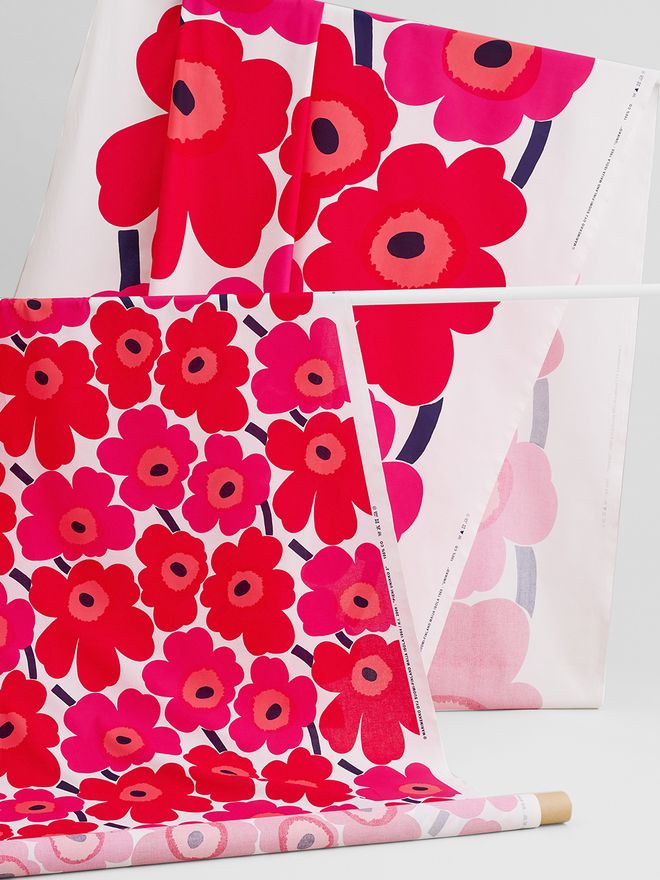
Around one million meters of fabric are printed at Marimekko’s Helsinki factory every year.
How Marimekko’s printed fabrics are made
At the drawing studio, print sketches are digitized, adapted into a format suitable for the printing process, and separated into color layers.
The pattern workshop then receives the print files and creates the required screens either by laser-engraving the design onto rotary cylinders or by exposing the pattern onto the mesh of a flatbed printing screen. The number of screens always depends on the print and the number of colors involved.
Designers provide color proposals, based on which the modeling coordinators search for recipes for the desired shades. Marimekko’s extensive color archive often already contains recipes for previously used tones. The colors are mixed in the color kitchen, partly by hand and partly with the help of automation.
Before the final printing stage, the colorways are tested on a sample printing machine. The sample printer is also used for product development and for testing, for example, recycled fibers and new printing dyes.
Finally, the print is transferred onto fabric using either rotary or flatbed printing. After printing, the fabrics are dried, after which the colors are fixed either with steam or through hot-air fixation, depending on the dye group. Once the colors have been fixed, the fabric is washed, finished as needed, and adjusted to the desired width.
Quality checks for fabric batches are carried out in the textile laboratory located alongside the printing factory. More than 5,000 tests are conducted annually at Marimekko’s in-house quality laboratory.
In the final inspection stage, quality inspectors examine every single meter of printed fabric produced at the factory. Once approved, the fabrics are ready to be sold by the meter or shipped to Marimekko’s contract manufacturers for the production of Marimekko products.
See also:
• Marimekko fabrics >
• All products by Marimekko >
Photos: Marimekko
Published on 21 May, 2026