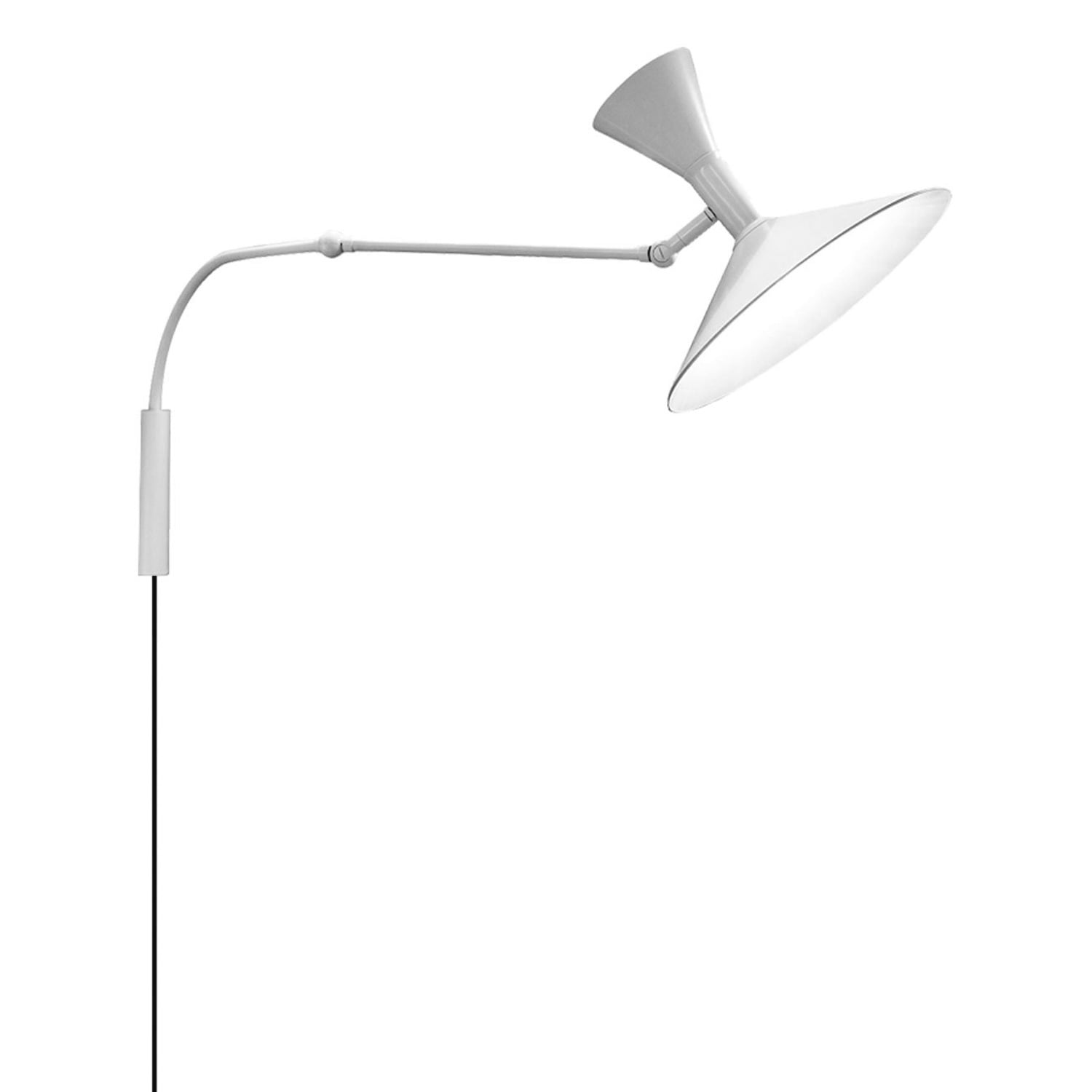
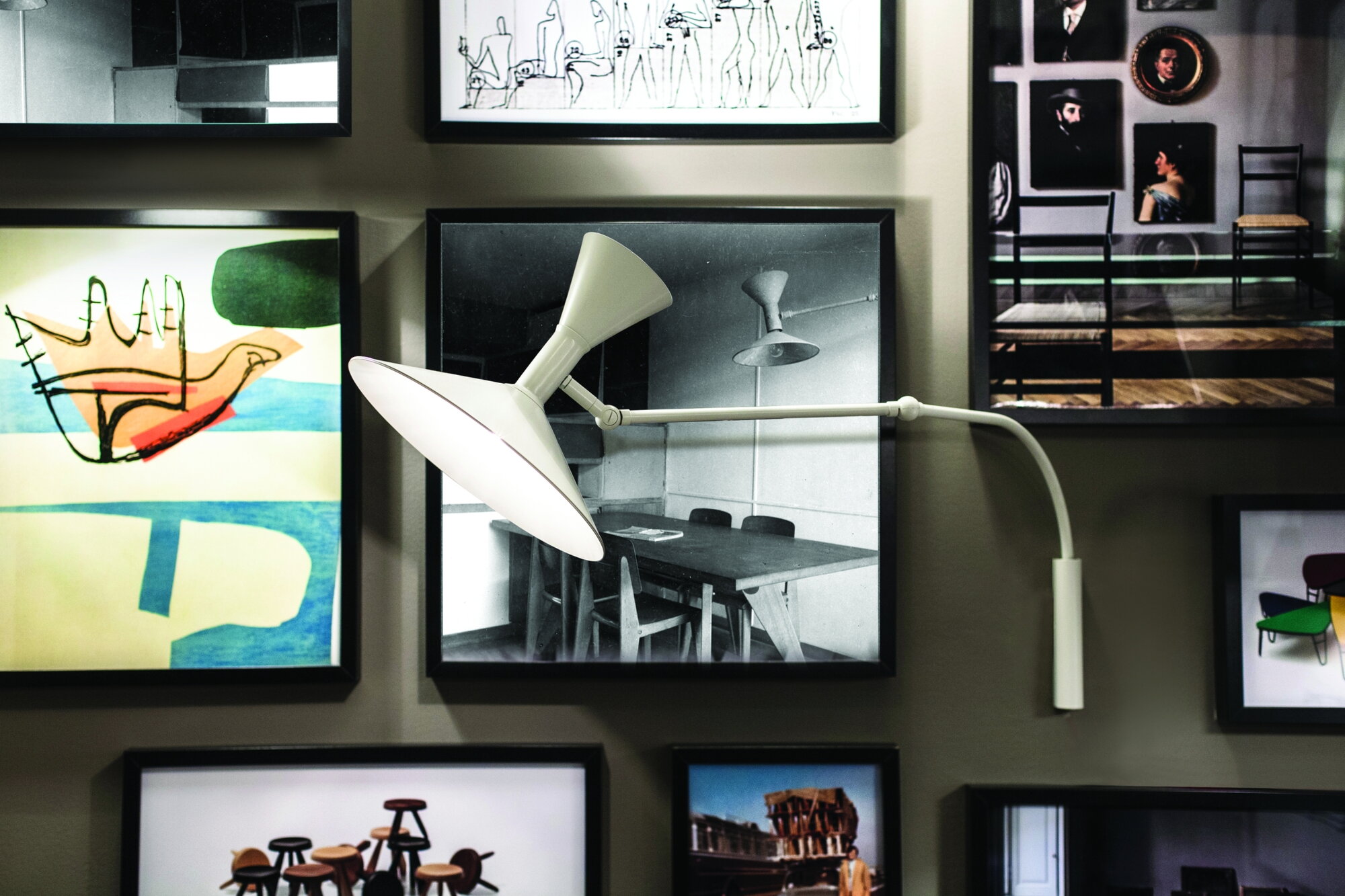
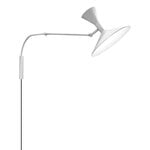
Nemo Lighting’s Lampe de Marseille Mini is a smaller version of the sculptural wall light designed by the world-famous architect Le Corbusier for the Unité d’Habitation in Marseille at the turn of the 1950s. The position of the light is easy to adjust since the arm features two joints and turns from side to side. The striking shade consists of two aluminum cones that offer direct and indirect light. Lampe de Marseille is a true statement piece that has and will stand the test of time.
This is a carousel. Use Next and Previous buttons to navigate, or select a thumbnail to jump to a slide.
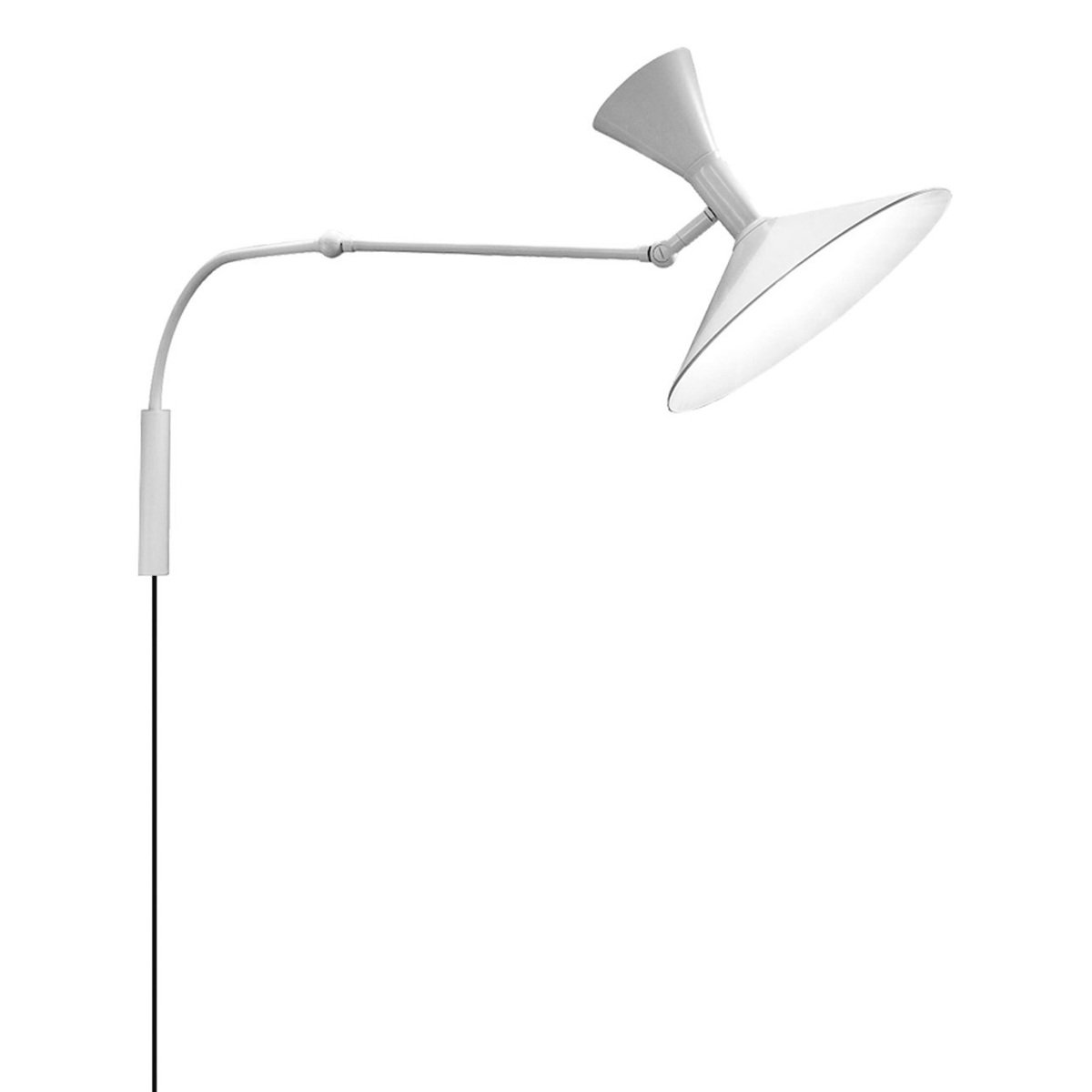
Lampe de Marseille Mini wall lamp, white
Description
Nemo Lighting’s Lampe de Marseille Mini is a smaller version of the sculptural wall light designed by the world-famous architect Le Corbusier for the Unité d’Habitation in Marseille at the turn of the 1950s. The position of the light is easy to adjust since the arm features two joints and turns from side to side. The striking shade consists of two aluminum cones that offer direct and indirect light. Lampe de Marseille is a true statement piece that has and will stand the test of time.
- Length: 35.43 in (90 cm)
- Width: 11.81 in (30 cm)
- Diameter: 11.81 in (30 cm)
- Shade diameter: 11.81 in (30 cm)
- Height: 19.69 in (50 cm)
- Measurement details: Shade height: 9.45 in (24 cm)
- Cable length: 62.99 in (160 cm)
- Material Steel, aluminum
- Colour White
- Bulb base E14
- Light source 2 x 5-7W LED (not included)
- IP rating 20
- Protection class II
- Voltage 230 V
- Nominal frequency 50–60 Hz
- Certifications and labels CE, EAC, UL
- Plug EU plug
- Cable colour Black
- Cable material Plastic
- Dimmable No
- Hardwired wall mount Yes
- Notes Switch on cable, hardwired wall mount also possible
- Product ID: NM-LMMEWW31

Le Corbusier (1887–1965), born Charles-Édouard Jeanneret-Gris, was a Swiss-born architect, theorist and designer who became one of the most influential modernists of the 20th century.
His thinking left a deep mark on 20th-century urban planning – particularly on functionalist housing districts and city renewal projects. His legacy extends beyond architecture into the world of design.
Le Corbusier – the radical reinventor of modern architecture
Le Corbusier – born Charles-Édouard Jeanneret-Gris – was a Swiss-born architect, designer, artist, writer and urban planner, best known as a pioneer of functionalism and modernist architecture. He first used the pen name Le Corbusier, a riff on his maternal grandmother's surname Lecorbésier, in 1920 in his own journal, L'Esprit Nouveau.
At 13, Le Corbusier enrolled at the École d'Art in La Chaux-de-Fonds, where he began by studying the enameling and engraving of watch faces before turning to painting and architecture. He designed his first house at 17, traveled widely across Europe on study trips, and worked for, among others, Auguste Perret and Peter Behrens. During the First World War, he also taught at his former school. Those early encounters with concrete construction and industrial architecture would prove decisive for everything that followed.
Five principles and the machine for living
Le Corbusier's architecture was shaped by his celebrated five points: raising the building on pilotis, the free floor plan, the independent façade, horizontal ribbon windows, and the roof garden. Together, these principles were his manifesto for liberating architecture from its traditional constraints.
He famously regarded buildings as machines for living in. The idea sounds cold, but behind it lay a genuinely idealistic impulse: light, air and space for everyone, not just the few. His most influential built works include Villa Savoye (1929–1931), Unité d'Habitation in Marseille (1947–1952), the city of Chandigarh in India (1954), and the Chapel of Notre Dame du Haut in Ronchamp (1955).
Design and proportion
Beyond architecture, Le Corbusier also turned his hand to furniture – most notably in collaboration with Charlotte Perriand and his cousin Pierre Jeanneret. His best-known design pieces include the LC4 Chaise Longue and the LC2 armchair, both manufactured by Cassina, as well as the Lampe de Marseille lights by Nemo Lighting.
He also developed the Modulor system – a scale of proportions based on human body measurements and the golden ratio, designed to bring the built environment into harmony with the human scale.
Who: Le Corbusier
- Swiss-French architect and designer (1887–1965), born Charles-Édouard Jeanneret.
- A central theorist of modern architecture; developed both the five points of architecture and the Modulor proportional system.
- In 2016, seventeen of his buildings were inscribed as UNESCO World Heritage Sites.
- Notable buildings: Villa Savoye, Unité d'Habitation and the Chapel of Ronchamp.
- Notable products: LC4 Chaise Longue, LC2 armchair (Cassina), Lampe de Marseille lights (Nemo Lighting).
Want to read more about Le Corbusier and his work? Browse our selection of books:
Read more in Design Stories
View all products5

5
4
3
2
1
Based on 1 reviews
-
A
Anonyymi | Verified Customer
Finland

1 year ago
This product does not yet have a sustainability rating.
Learn more.
This is a carousel. Use Next and Previous buttons to navigate.