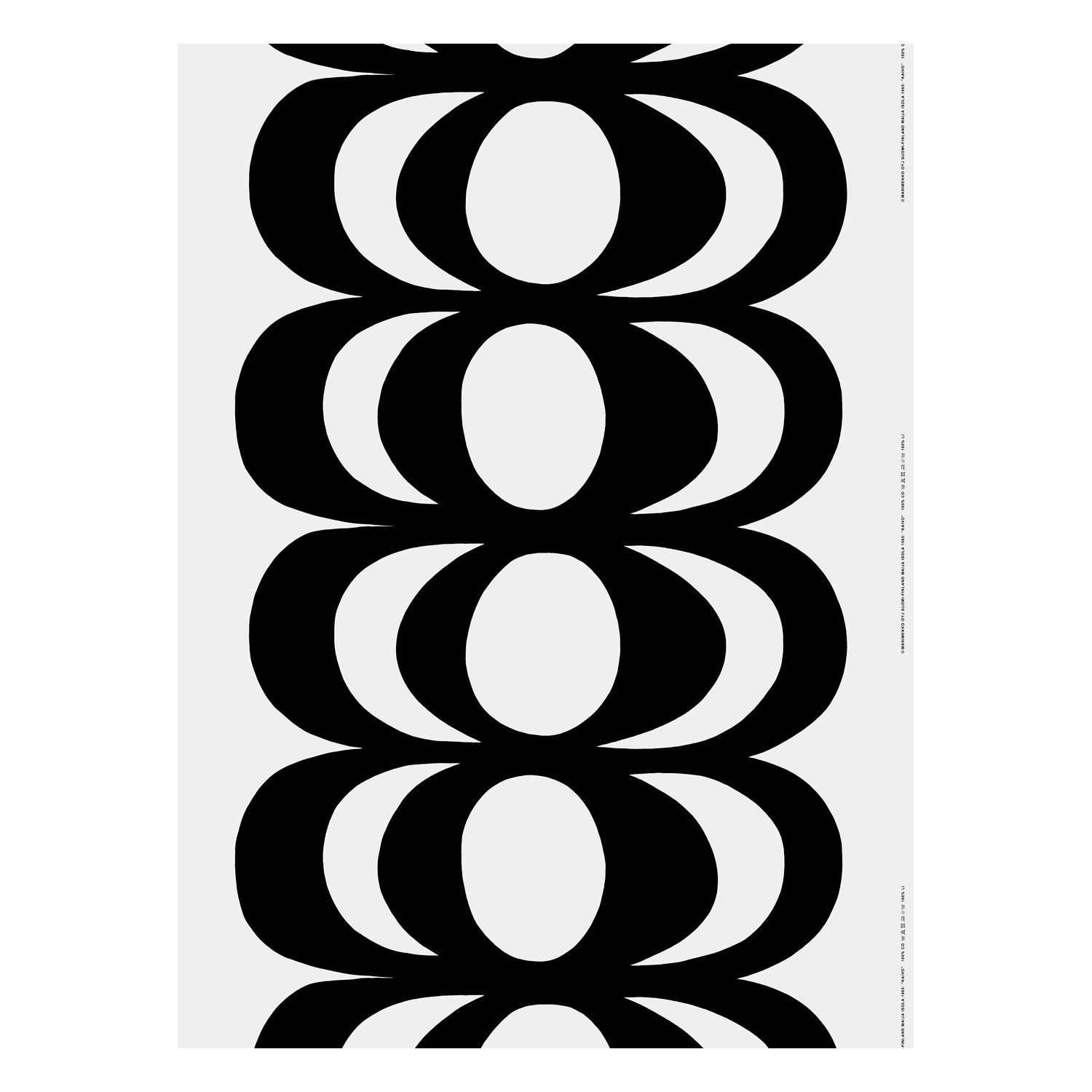
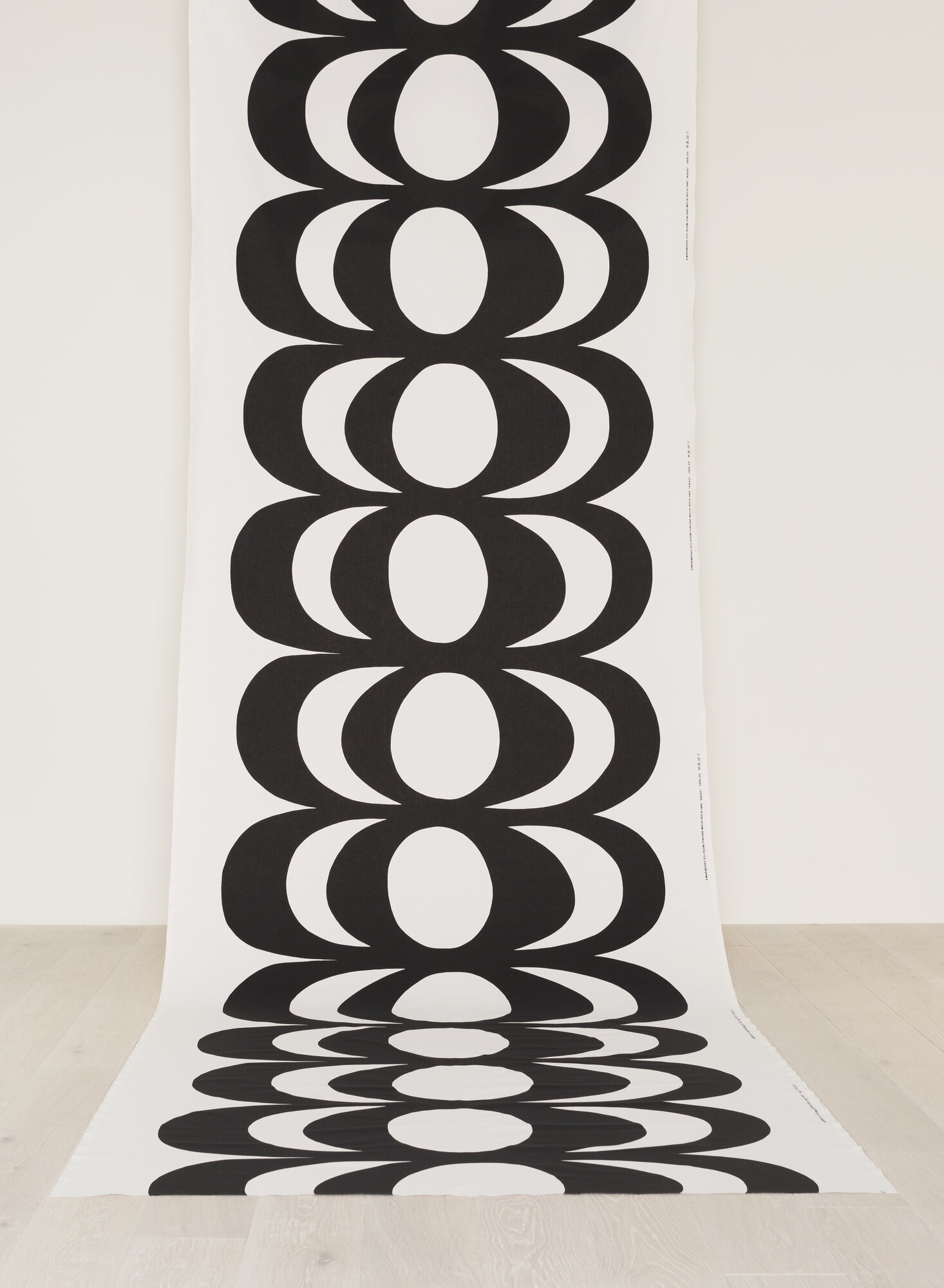
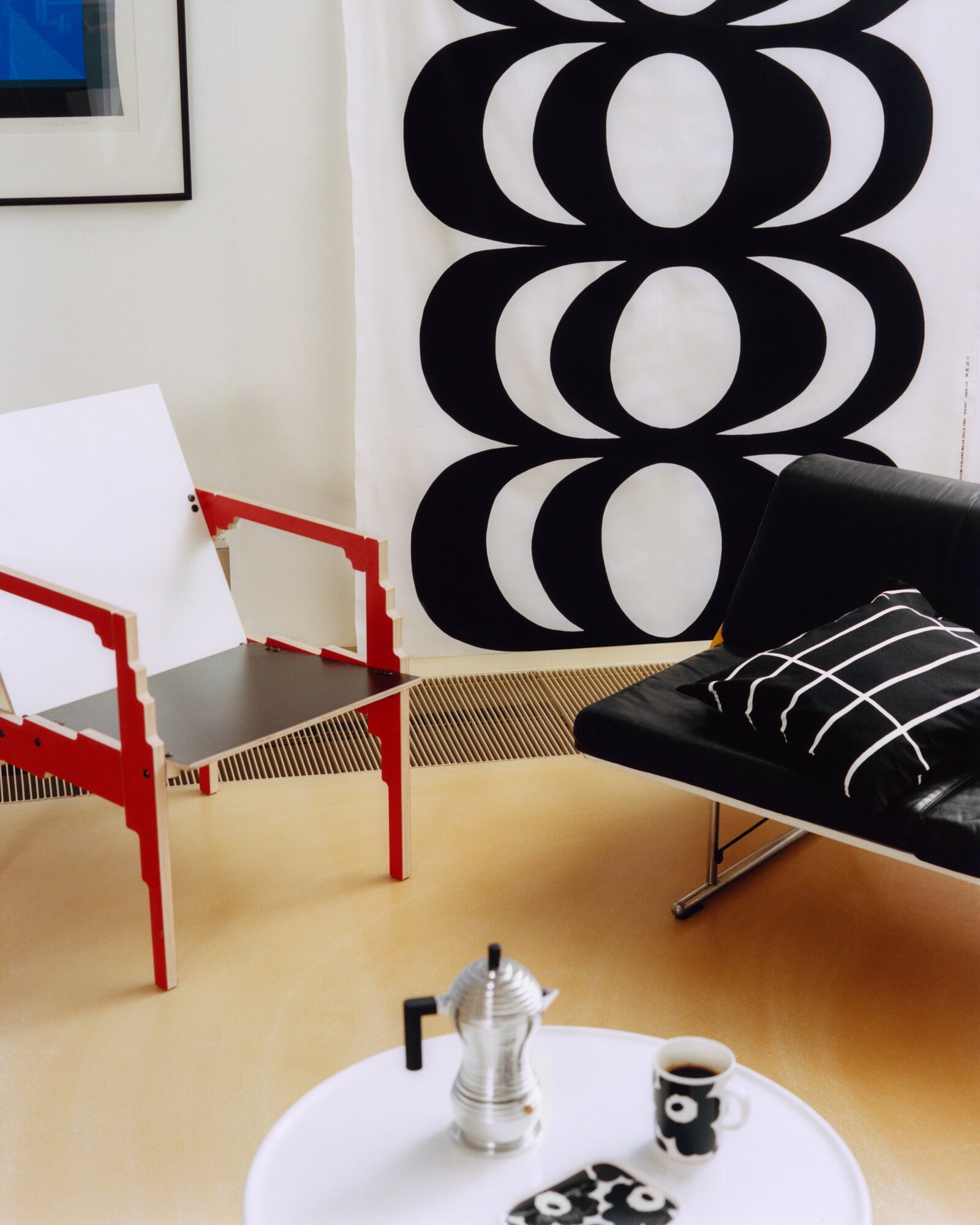
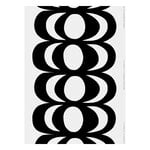
Marimekko’s Kaivo (Finnish for ”well”) was created by the designer Maija Isola, who got the inspiration at a well while watching the rings that formed on the surface of the water. The heavyweight cotton has been printed in Helsinki, Finland.
This is a carousel. Use Next and Previous buttons to navigate, or select a thumbnail to jump to a slide.

Kaivo fabric, white-black
Description
Marimekko’s Kaivo (Finnish for ”well”) was created by the designer Maija Isola, who got the inspiration at a well while watching the rings that formed on the surface of the water. The heavyweight cotton has been printed in Helsinki, Finland.
- Repeat: 34.65 in (88 cm)
- Material 100 % heavyweight cotton
- Colour White, black
- Size Width 58.27 in (148 cm) (+-2 %)
-
Notes
This fabric is sold by the meter and comes in one continuous length. Add the number of meters required into the Quantity box.
Please note that the maximum continuous length is 15 meters. - Product ID: MA063003-001

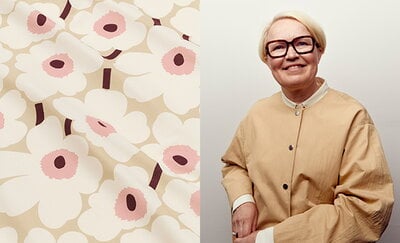
Textile designer and artist Maija Isola (1927–2001) is arguably Marimekko's best-known pattern designer and one of the international trailblazers of Finnish textile design. Having designed over 500 prints, Isola created timeless classics with her bold use of color and large-scale patterns, the most famous being Unikko, launched in 1964.
Isola's work brings together artistic freedom, international influences and vibrant, daring patterns.
Maija Isola – bold reformer of Finnish textile design
Maija Isola is one of the most central names in Finnish textile art. She drew her first prints for Marimekko's predecessor, Printex Oy, in 1949 and served as Marimekko's chief designer of fabrics until 1987.
Isola was an exceptionally prolific and versatile designer: her print production comprises over 500 designs. Her work spanned everything from powerful floral patterns and abstract compositions to ornamental and folk-art-inspired motifs.
The rebellious Unikko
Maija Isola's best-known print is Unikko. Unikko was launched in 1964, despite the fact that Marimekko's founder Armi Ratia had expressly forbidden the design of floral prints. Isola paid no heed to the ban, however, and designed a series of magnificent floral prints, the beloved Unikko among them. Today Unikko is undoubtedly more popular than ever, and a vast array of Unikko-themed products and colourways is available.
In the 1960s, Marimekko's prints also gained international attention, and Isola's bold use of color and large-scale patterns defined a new direction for Finnish textile design.
A cosmopolitan artist
Maija Isola drew inspiration for her fabric designs from traditional folk art as well as modern visual art, nature and her travels around the world. She lived and worked for long stretches in France and Africa, among other places, which was reflected in the rhythm and color palette of her prints. Alongside textile design, Isola also worked as a visual artist.
In the 1980s, Isola began designing fabrics in collaboration with her daughter Kristina Isola. Together they created fresh floral prints, bold abstract patterns and ornamental designs that became Marimekko classics. After Maija Isola's death in 2001, Kristina Isola continued her mother's work by designing new colourways for Maija Isola's prints.
Who: Maija Isola
- Finnish textile artist and pattern designer (1927–2001).
- Worked as Marimekko's chief designer from 1949 to 1987.
- Designed over 500 printed patterns.
- A key figure in the international breakthrough of Finnish textile design.
- Notable works: Unikko (1964), Kaivo (1965), Melooni (1963), Lokki (1961), Kivet (1956), Mansikkavuoret (1969).
Read more in Design Stories
View all products5

5
4
3
2
1
Based on 7 reviews
-
C
Christiane W | Verified Customer
Krefeld, Germany

2 years ago
-
E
Erja A | Verified Customer
Helsinki, FI
6 months ago
-
T
Tiina L | Verified Customer
Finland
1 year ago
The Product Sustainability Framework, our criteria of sustainable design, helps you find the most sustainable products in our selection. Read below which sustainability criteria this product has met.
-
 Equal opportunities for all employees
 -
Commitment to UN Global Compact, fair compensation for all employees
-
Corporate responsibility requirements defined and communicated for suppliers
-
Systematic work for improved inclusion and well-being in the workplace
-
Transparent supply chain
-
Suppliers' compliance to a code of conduct ensured
-
Direct suppliers audited and certified
-
Compliance to the UN Guiding Principles on Business and Human Rights ensured in the supply chain
-
Support for community involvement in the supply chain
-
Fair and resource-wise water-use in production
-
No incineration or landfilling of returned items
-
No use of endangered species as materials
-
No direct environmental emissions or waste (excl. GHGs) from production
-
The sustainability of direct suppliers' production is addressed and monitored
-
Material-efficient and ecological packaging
-
Production and material sourcing that respect biodiversity, animal rights, and natural ecosystems
-
Positive impact on nature’s well-being through operations that regenerate natural ecosystems
-
No potentially harmful chemicals used in own production
-
Company's direct greenhouse gas emissions identified and commitment to reduction
-
Product's carbon impact identified and commitment to reduction
-
Guidance on energy- and eco-efficient use of the product
-
Contribution to climate initiatives beyond the brand’s direct operations
-
Low-carbon or compensated transportation
-
Carbon footprint of the product calculated and goals set to reduce it
-
100 % renewable energy in own production and operations
-
Carbon neutral or carbon negative product
-
Sustainable and long-lasting material choices
-
No harmful or hazardous substances
-
Responsible raw material sourcing and production
-
Materials suited for circularity: monomaterials, recyclable finishings, renewable or recycled contents etc.
-
Ecological materials: natural, biodegradable, recyclable or recycled contents
-
Outstanding materials in terms of innovativeness, responsibility, sustainability and circularity: local production or sourcing, 100 % recycled content, C2C-certification etc.
-
High aesthetic quality promoting long-term use of the product
-
Technically durable product design and material choices
-
Design for enduring life-long quality
-
Design and support for product maintenance, repair and upgradability
-
Innovative circular design solutions: circular service system, resale platform, remanufacturing, collection of used products, etc.
This is a carousel. Use Next and Previous buttons to navigate.