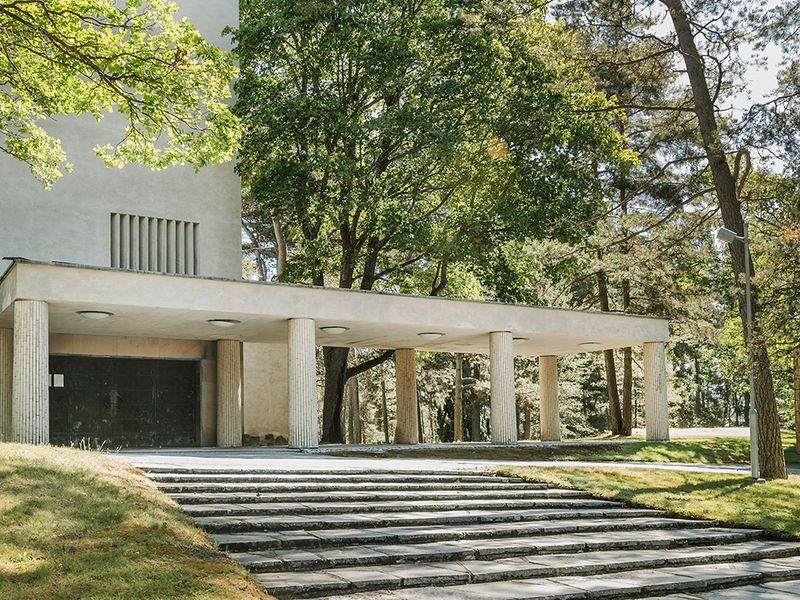
Eero Saarinen’s iconic design transformed: TWA Hotel breathes new life into a decommissioned airport terminal
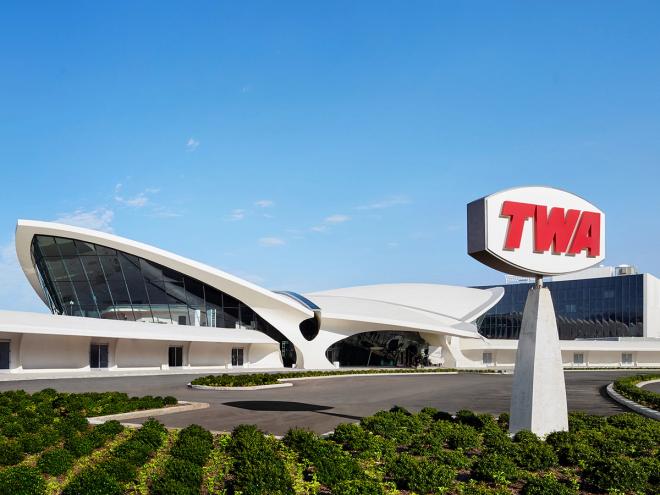
The silhouette of Eero Saarinen’s TWA terminal resembles a bird in flight.
AFTER FALLING QUIET for almost two decades, the TWA Terminal of John F. Kennedy International Airport is throbbing with life. Recently opened in the restored terminal, the TWA Hotel received its first guests in May 2019. Even before officially opening, the iconic building was the setting for a fashion show featuring the Cruise 2020 collection by Louis Vuitton.
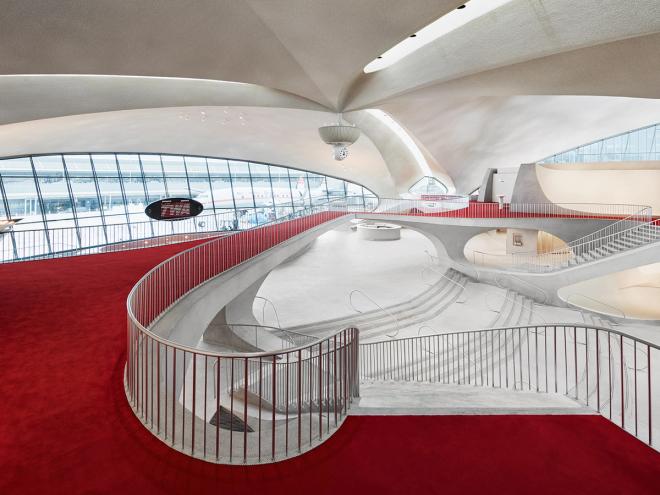
The interiors are dominated by a combination of cool white and warm red, a hue which was developed by Saarinen himself.
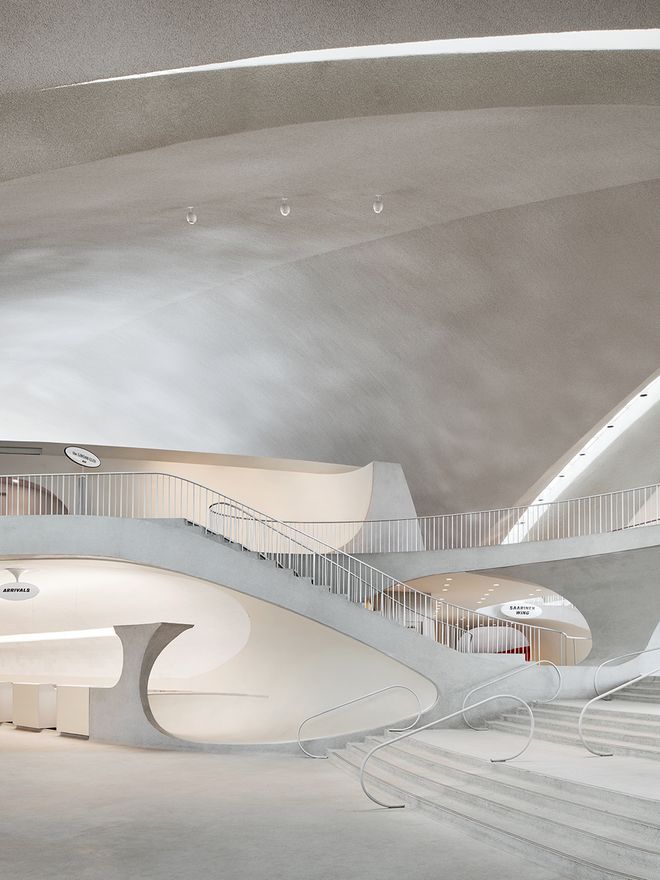
Visitors are welcomed by the curved lines of the lobby.
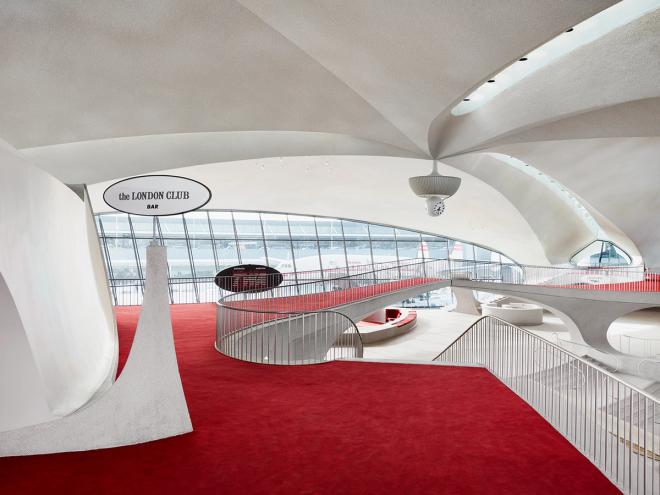
The main building of the hotel houses several restaurants and bars.
The TWA Flight Center, which was designed by Eero Saarinen and completed in 1962, is one of New York's national historical landmarks. In architectonic terms, it is one of the most famous airport buildings in the world. Its attenuated concrete structures that open out like wings, sloping window walls and the soft curvature of the interior spaces reflect the aesthetic of the sixties neo-futurism and space-age Googie architecture. The milieu has also been made familiar by several movies, such as Steven Spielberg's Catch Me If You Can.
The TWA Flight Center is one of the most famous airport buildings in the world.
Despite its futuristic look, the terminal, which was designed in the age of the propeller plane, soon turned out to be too small for jet planes and was expanded already in the 1960's. The TWA Flight Centre closed its doors to air passengers in 2001, when Trans World Airlines, the airline which owned the terminal, wound up its operations.
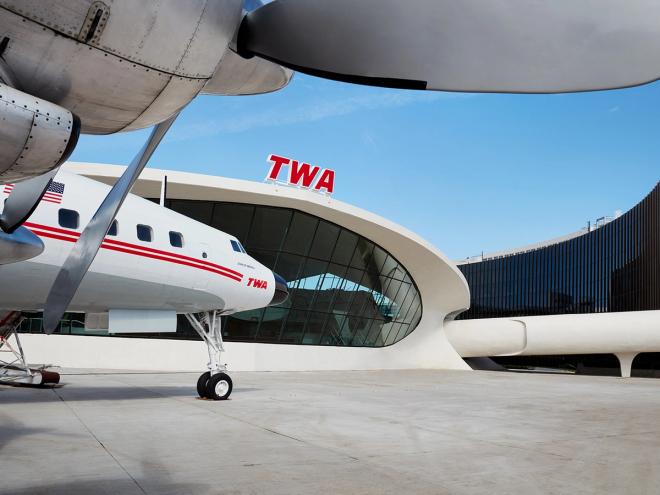
Lockheed Constellation propeller plane ”Connie” from 1958 now serves as a cocktail lounge.
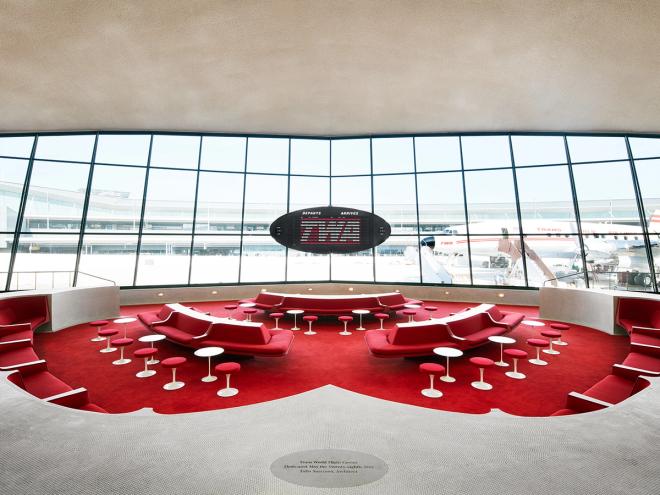
Framed with round penny tile flooring, The Sunken Lounge has been restored to its original glory.
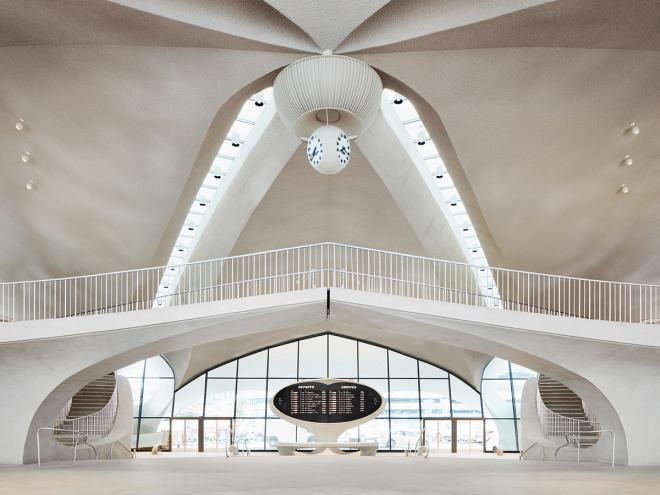
Manufactured by the Italian Solari di Udine, the old split-flap departure board is still at its place.
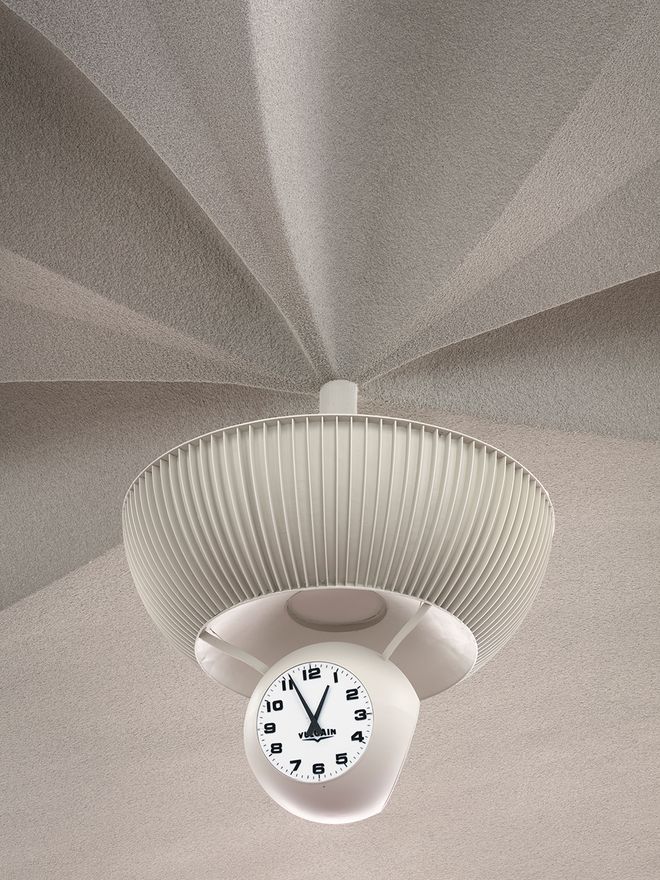
In the centre of the terminal’s ceiling, a Swiss Vulcain clock ticks on.
The fully restored terminal houses the TWA Hotel's lobby, conference facilities and several restaurants and bars, including the original Paris Café. Saarinen's famous tubular passageways connect the building to the new terminal surrounding it.
In terms of its overall visual image, the TWA Hotel is pure 1960's.
In terms of its overall visual image, the hotel is pure 1960's. Developed by Saarinen himself, the vibrant red tone Chili Pepper Red of the carpeting in the corridors and sunken lounge contrasts with the white surfaces. A museum presenting the history of TWA, the jet age and the mid-20th century design has also been opened in the hotel.
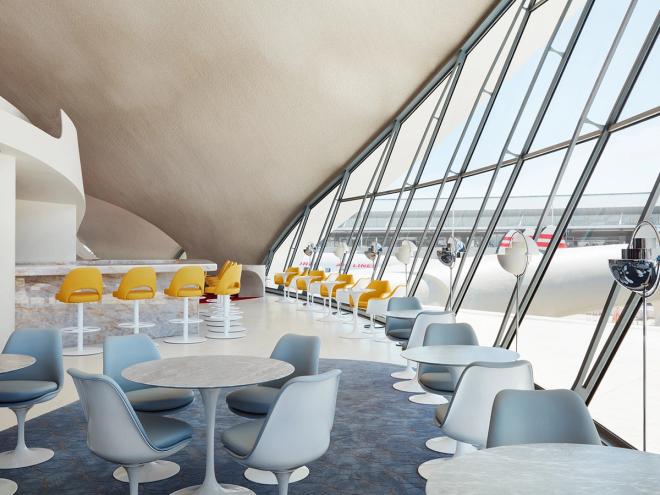
The original Paris Café is now a 200-seat restaurant by the top chef Jean-Georges Vongerichten. The restaurant is furnished with Gubi’s Multi-Lite lamps and Knoll furniture.
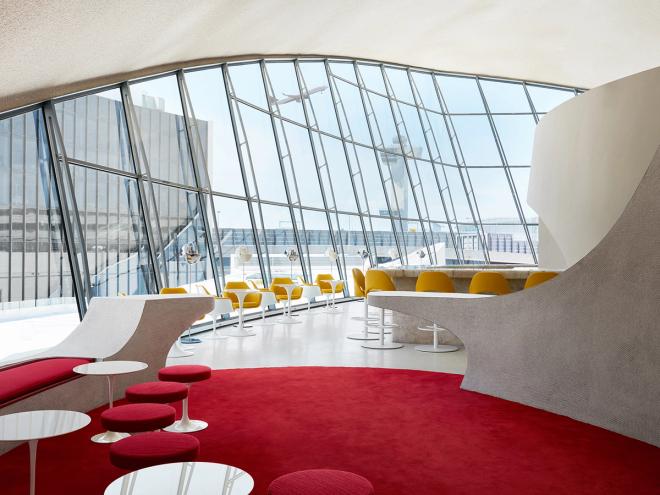
The large windows of the restaurants provide a view of planes taking off and landing.
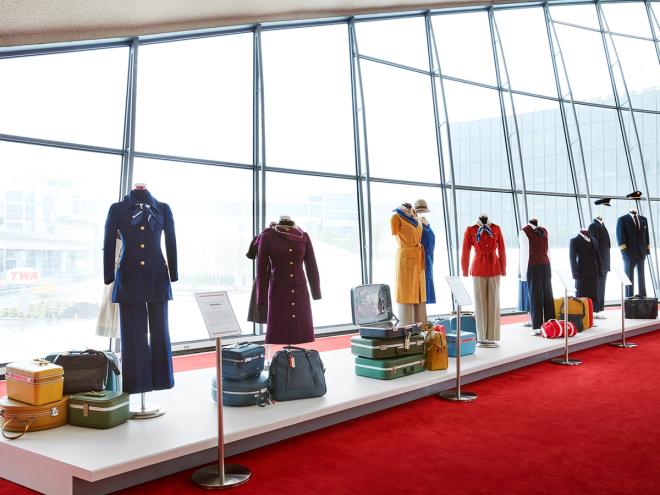
A collection of vintage TWA crew uniforms – including those designed by Valentino, Stan Herman and Ralph Lauren – are on display at the TWA Hotel.
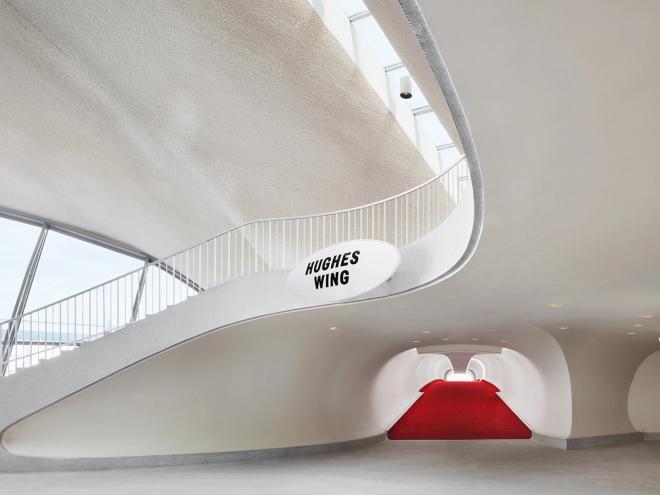
The famous red and white flight tubes have been featured in several movies. Now they lead to the new hotel buildings.
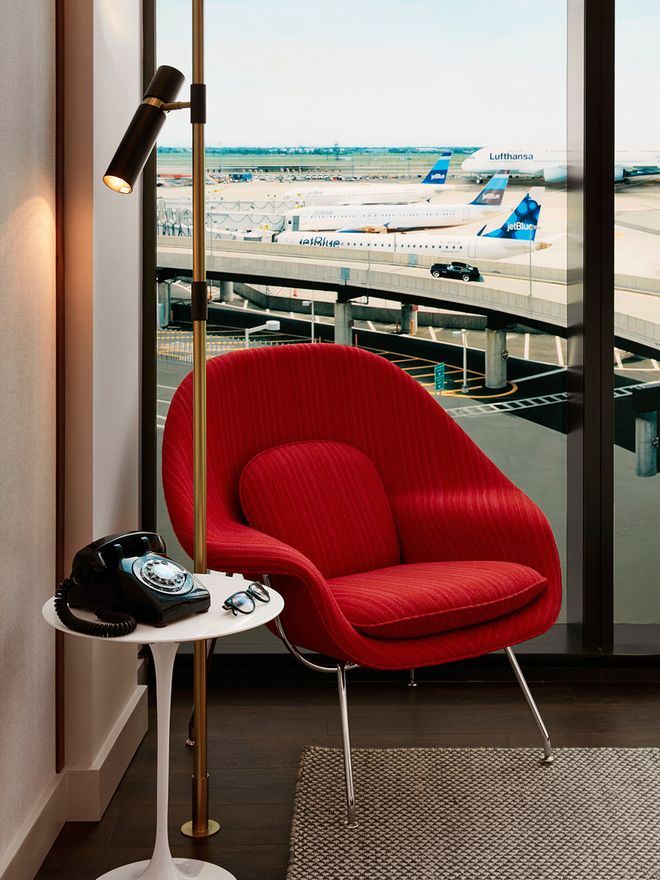
Saarinen’s furniture designs can also be found inside the hotel rooms – the red Womb chair is from 1946 and the white Tulip table from 1957.
The 512 rooms in the new buildings located beside the old terminal have interior decor in the spirit of Saarinen – they have been furnished with items such as the Womb chairs and Tulip tables that Saarinen designed for Knoll. The over 10-centimeter thick, specially made windows guarantee a peaceful night's sleep, and the infinity pool on the rooftop overlooks the runways.
The project was carried out by the hotel real-estate chain MCR/MORSE Development in collaboration with the JetBlue airline and the Port Authority of New York and New Jersey.
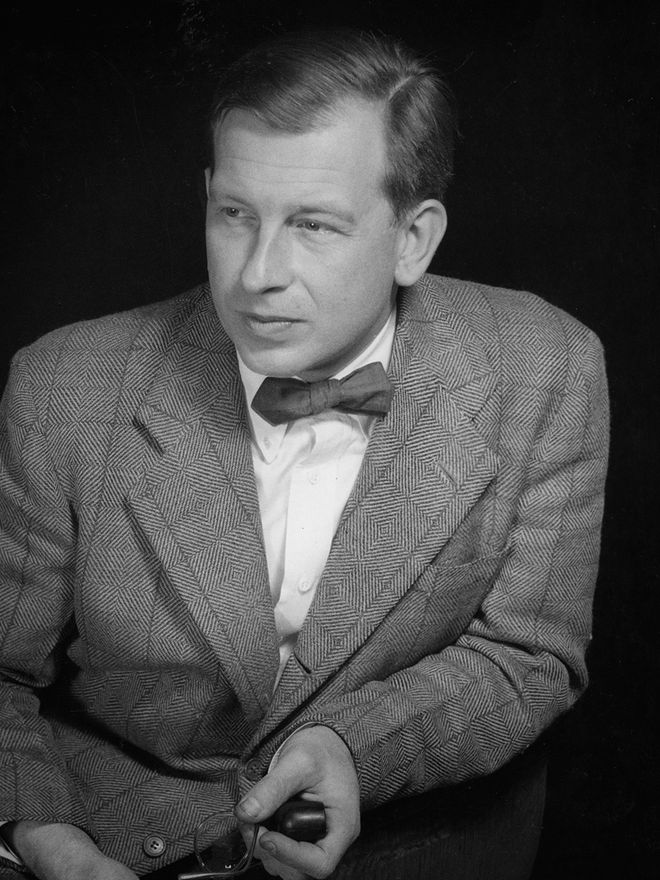
Architect Eero Saarinen (1910–1961). Image courtesy of Museum of Finnish Architecture.
Who? Eero Saarinen
A Finnish-American architect and designer
The child of architect Eliel Saarinen and textile artist Loja Saarinen; born in Kirkkonummi, Finland in 1910 and died in Ann Arbor, Michigan, in 1961
Studied sculpture in Paris, architecture at Yale University and design at the Cranbrook Academy of Art in Michigan
Alongside Charles Eames, won a design competition arranged by MoMA in 1940
Best-known work: TWA Flight Center, Dulles International Airport in Washington DC, St. Louis' Gateway Arch, and the Womb chair and Tulip furniture for Knoll
See also:
• All designs by Eero Saarinen >
• Saarinen book by Taschen >
Photos: TWA Hotel / David Mitchell and Max Touhey
The story was first published in 2019.
Published on 24 Jan, 2025