This is a carousel of product images. Use the thumbnails or swipe to change the displayed image, and activate an image to open it full screen.
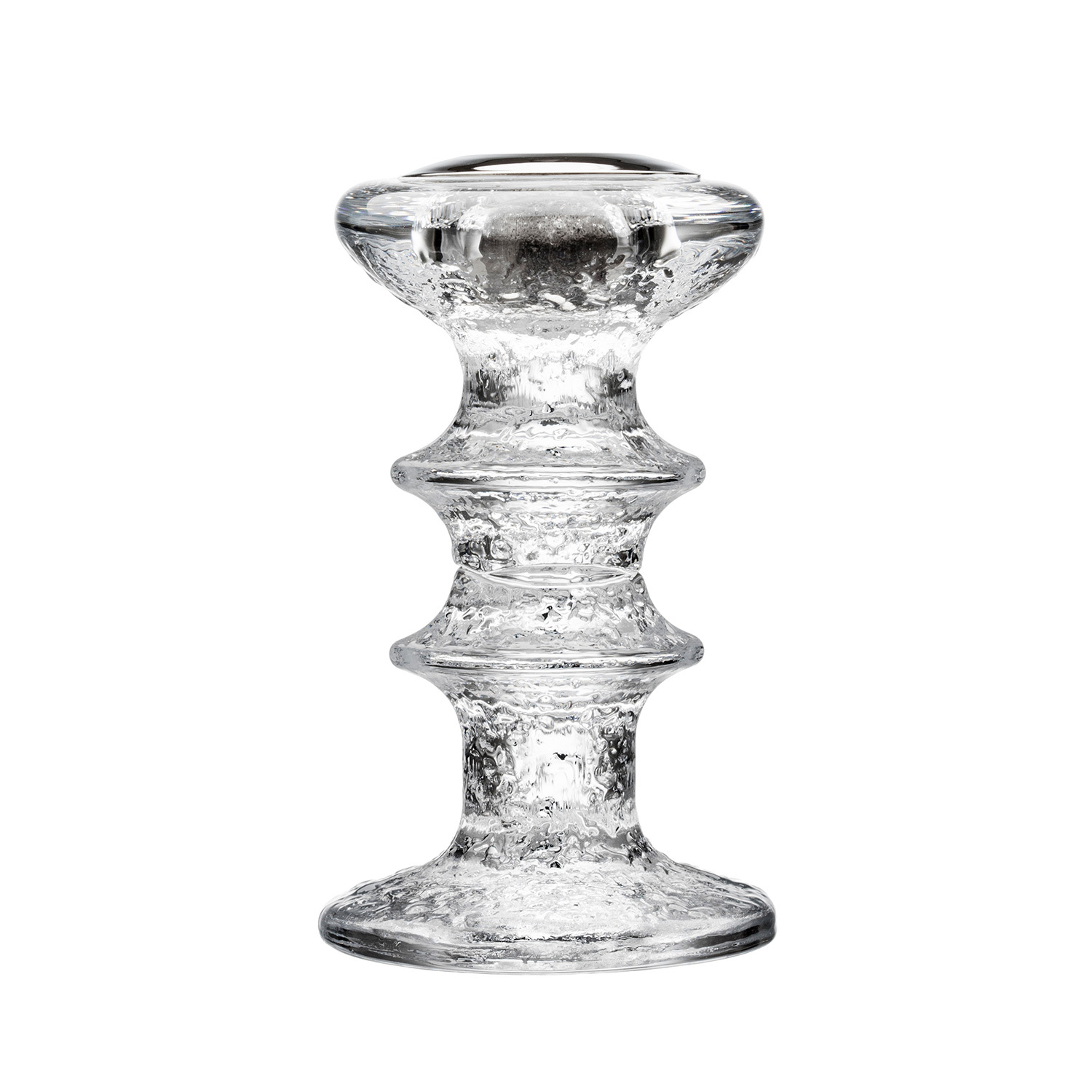

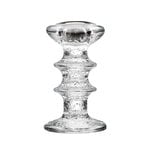
Festivo candleholder, 120 mm
Description
The Festivo candleholders were designed by Timo Sarpaneva for Iittala in 1966. The striking glass objects feature an ice-like, textured design and come in various heights. Create a beautiful candle display with a single or several candleholders – Festivo is a timeless Finnish design classic that will suit any setting and style. Festivo candleholders are made at the Iittala glassworks in Finland.
- Width: 8 cm
- Height: 12 cm
- Diameter: 8 cm
- Material Glass, metal
- Colour Clear
- Notes Since autumn 2016 the Festivo candleholders come with a non-removable metal candle cup that suits a larger range of candles and prevents the candleholder from breaking, should the candle burn out.
- Care instructions Wash by hand only
- Product ID: II1023745

Timo Sarpaneva (1926–2006) was one of the central reformers of Finnish design and one of the designers who brought Finnish design to international awareness in the 1950s and 1960s. As a multidisciplinary designer and artist, he worked with metal, ceramics, textiles and graphics, among other things, but he is best known for his pioneering glass design.
Sarpaneva’s career was particularly strongly tied to Iittala, where he began as a designer in the early 1950s. The classic Festivo candleholders, Tsaikka glasses and Sarpaneva pot are still part of Iittala’s production.
Timo Sarpaneva – an international trendsetter of Finnish glass design
Timo Sarpaneva is one of the great names of Finnish design. Having graduated from the Institute of Industrial Arts in 1948, Sarpaneva trained as a graphic designer, but his career focused mainly on industrial design. He made Finnish design internationally known and worked for a long time with Iittala.
Sarpaneva also designed Iittala’s well-known letter i in 1956, which became one of the most recognisable symbols of Finnish design.
Classics of glass art
Sarpaneva’s design brings together a powerful artistic vision, an exceptional knowledge of materials and a desire to push the boundaries of industrial design towards a more sculptural expression.
As a glass designer, he was interested in how the surface, colour, layering and reflection of light in glass could be used as a means of expression. In the Festivo candleholders made by Iittala, a rugged, ice-like surface meets a pared-back, architectural form, while the metal holders of the Tsaikka glasses were inspired by surplus sheets from a zip factory.
A master of many materials
Sarpaneva’s international breakthrough came in the 1950s, when Finnish design began to rise to worldwide visibility. The Milan Triennials played a central role in this development, and Sarpaneva was honoured at them on several occasions. In addition, House Beautiful magazine chose his Orkidea art glass sculpture as the most beautiful object of 1954.
In addition to glass, Sarpaneva also designed textiles, porcelain, cast-iron objects and exhibition architecture, and collaborated with several Finnish and international manufacturers. The cast-iron pot Sarpaneva designed for Iittala is still one of the best-known classics of Finnish functional design.
Who: Timo Sarpaneva
- Finnish designer and professor (1926–2006).
- Worked with Iittala for almost 50 years and also designed the company’s iconic i logo.
- His design is characterised by material experiments, sculptural expression and a design language inspired by nature.
- Recognition: the Grand Prix at the Milan Triennale in 1954, the Lunning Prize in 1956, the Pro Finlandia Medal in 1958, the title of professor in 1976, and an honorary doctorate from the University of Art and Design Helsinki in 1993.
- Notable products: the Festivo candleholders, the Tsaikka glasses, the Sarpaneva pot and the Orkidea and Claritas art glass objects.
Ideas and inspiration
This is a carousel. Use Next and Previous buttons to navigate.