This is a carousel of product images. Use the thumbnails or swipe to change the displayed image, and activate an image to open it full screen.
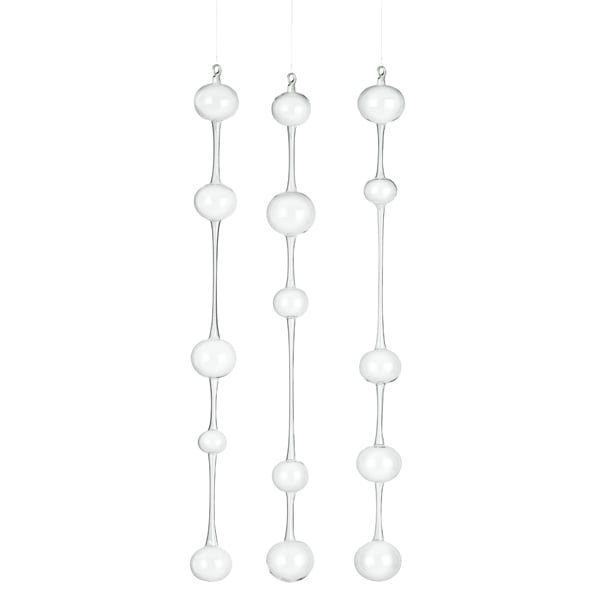
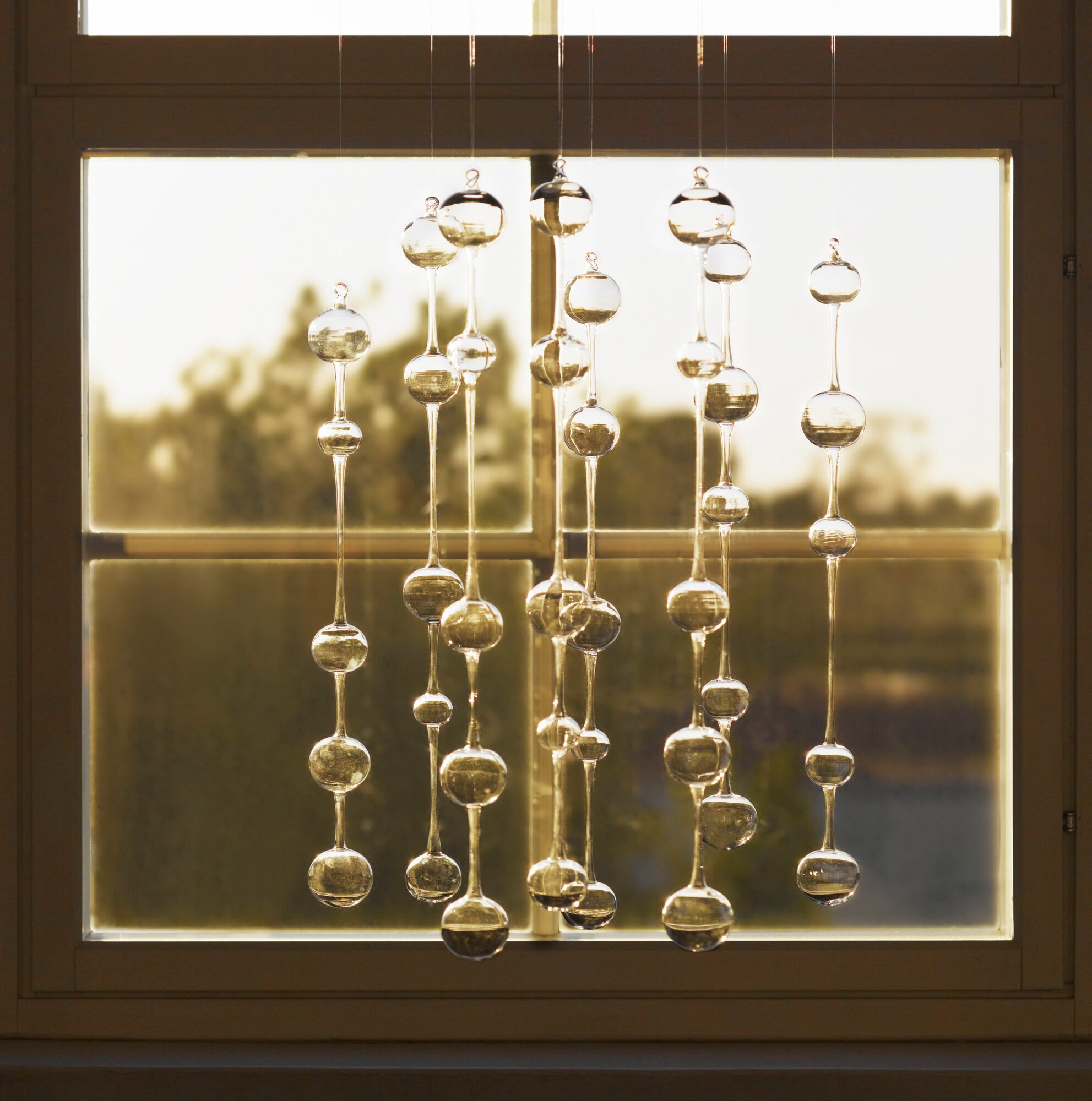
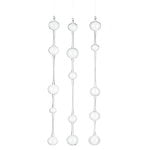
Morning in Athens, set of 3
Description
Morning in Athens is a sculpture made of glass pendants. For this sculpture, Kaj Franck was inspired by the beauty of Greece. When moved by the wind, the fragile orbs issue a soft, metallic sound reminiscent of the church bells of Athens on a Sunday morning. Morning in Athens was in production during the years 1954-1975 and 1992-1994 at the Nuutajärvi factory, the oldest glass factory in Finland, and has now being reintroduced. Made from hand-blown glass, Morning in Athens is available in three slightly different models and this set includes all three.
- Colour Clear
- Size Length 630 mm
- Material Hand-blown glass
- Notes Hanging thread includes the package.
- Product ID: II112081

The world may change at a dizzying pace, but some truths hold steady across the years and decades: simple is beautiful. This was the guiding conviction of Finnish ceramics and glass designer Kaj Franck (1911–1989), whose legacy lives on as one of the cornerstones of Finnish design.
"I want to make everyday objects so self-evident that you don't even notice them," Franck once said of his work. Among his most celebrated creations are the Teema and Kartio series, both today part of Iittala's collection – understated, endlessly versatile designs that continue to win over new generations.
Kaj Franck – the conscience of Finnish design
Born in Viipuri in 1911, Finnish designer Kaj Franck studied at the Central School of Arts and Crafts in Helsinki, graduating as an interior architect in 1932. He worked at Riihimäki Glass and managed a textile printing factory in Hyvinkää before finding his true calling in design.
Franck's work always centred on people's basic needs and the objects that serve them – the essential things of everyday life. He believed in affordable mass production and had little time for materialism, disposability or ostentation. His world was built from pure geometric forms, with bold colours as their only adornment.
Franck has been called "the conscience of Finnish design", and he was one of the earliest advocates of recycling and sustainability in Finnish design.
Simplistic classics
Over the course of his career, Franck designed for Iittala, Arabia, Artek and the Nuutajärvi glassworks, among others.
Launched in 1953, Arabia's Kilta tableware was a radical statement against the traditional multi-piece dinner service: the collection was designed so that pieces could be bought one at a time, according to individual needs. Kilta was relaunched in 1981 as Teema. Franck's beloved Kartio glassware dates, which is based on simple conical forms, back to 1958. Both Teema and Kartio are today produced by Iittala and firmly established as icons of Finnish design.
Awards and legacy
Alongside his design work, Franck taught at the Finnish Institute of Industrial Arts from 1945, serving as artistic director from 1960 to 1967 and as senior lecturer from 1967 to 1969. He was also artistic director at the Nuutajärvi glassworks from 1950 to 1973.
His career brought wide recognition: multiple prizes at the Milan Triennale, the Compasso d'Oro, the Prince Eugen Medal, the Pro Finlandia Medal and the Lunning Prize. The prestigious Kaj Franck Design Prize, awarded annually by Design Forum Finland since 1992, bears his name.
Franck was granted the title of professor in 1972 and served as artist professor from 1973 to 1978. In 1983, he was awarded an honorary doctorate by the Royal College of Art in London.
Kaj Franck in brief
- One of Finland's most internationally recognised designers (1911–1989).
- Artistic director at the Nuutajärvi glassworks; teacher and director at the Institute of Industrial Arts.
- Philosophy: sustainable, democratic and timeless design – strip away everything unnecessary.
- The Kaj Franck Design Prize is awarded annually to a designer carrying on his legacy.
- Best-known works: Teema tableware (originally Kilta) and Kartio glassware.
Read more in Design Stories
View all products4.67
Based on 3 reviews
-
A
Anonymous | Verified Customer
Sakai, Japan


The product is beautiful! When the product was shipped, we found out that one of the sets was broken, which made us sad. But we really appreciate that Finnish design shop quickly replied our message and solved the problem.
1 year ago
-
G
Greg G | Verified Customer
United States
A beautiful and minimilist touch to my living room
2 years ago
-
S
Sari V | Verified Customer
""
2 years ago
Ideas and inspiration
This is a carousel. Use Next and Previous buttons to navigate.